Disclosure: ToddlerTravelGear is reader-supported. We may earn a commission if you buy through links on our site — at no extra cost to you. Learn more
Best Airplane Comfort & Entertainment for Toddlers (2026)
Researched picks for headphones, ear protection, tray setups, busy boards, and safety gear that actually keep toddlers happy on flights. $29.95.
You are at 35,000 feet. The seatbelt sign just came on during a rough patch of turbulence, your 22-month-old has flung her snack cup under the seat in front of you, and the man in 14C is doing that thing where he sighs loudly and turns around to look at you. You reach into your bag, pull out a fresh activity, hand it over, and your toddler is quietly absorbed for the next twenty minutes. That scenario is not a fantasy. It is what happens when you pack the right gear.
Most of them are fine. A few are genuinely life-changing. And some are a waste of money and precious carry-on space.
This guide covers the gear that actually works: hearing protection so your baby sleeps through engine noise, entertainment that buys you real stretches of quiet, tray setups that keep crayons from rolling into the aisle, and safety equipment that lets you skip lugging a car seat down the jetway. Every product here has been used on real flights with real toddlers who do not care about your boarding pass or your carefully planned itinerary.
How we chose these products
We evaluated over 30 airplane comfort and entertainment products based on criteria that matter at 35,000 feet:
- Noise performance — Does the hearing protection actually reduce enough decibels to matter? Does the volume limiter on the headphones truly cap at a safe level?
- Engagement time — How many minutes of focused attention does this activity actually buy you? We weigh this against manufacturer age guidance and the engagement patterns buyers report by age band.
- Packability — Every cubic inch of your carry-on is precious. We eliminated anything that is bulky relative to its usefulness.
- Mess factor — Anything that creates crumbs, stains, or small pieces that roll under seats got penalized. Airplane cleanup is not optional when you are in row 27.
- Safety certifications — For hearing protection and restraint systems, we verified all claimed certifications (CE, ANSI, FAA).
- Age versatility — Products that work across a wider age range scored higher because toddlers grow fast and you do not want to rebuy gear every six months.
We also factored in real parent feedback from thousands of verified reviews, paying special attention to comments about actual in-flight use rather than general at-home impressions.
Our top picks at a glance
Hearing Protection
Airplane cabins are loud — typically 80 to 85 decibels during cruise, and louder during takeoff and landing. That is roughly the noise level of a vacuum cleaner running inches from your child's head for hours. Hearing protection is not optional for babies and toddlers. It also has a secondary benefit that many parents do not expect: reducing sensory overwhelm often makes it dramatically easier for young children to fall asleep on flights.
1. Kidrox Wired Toddler Headphones
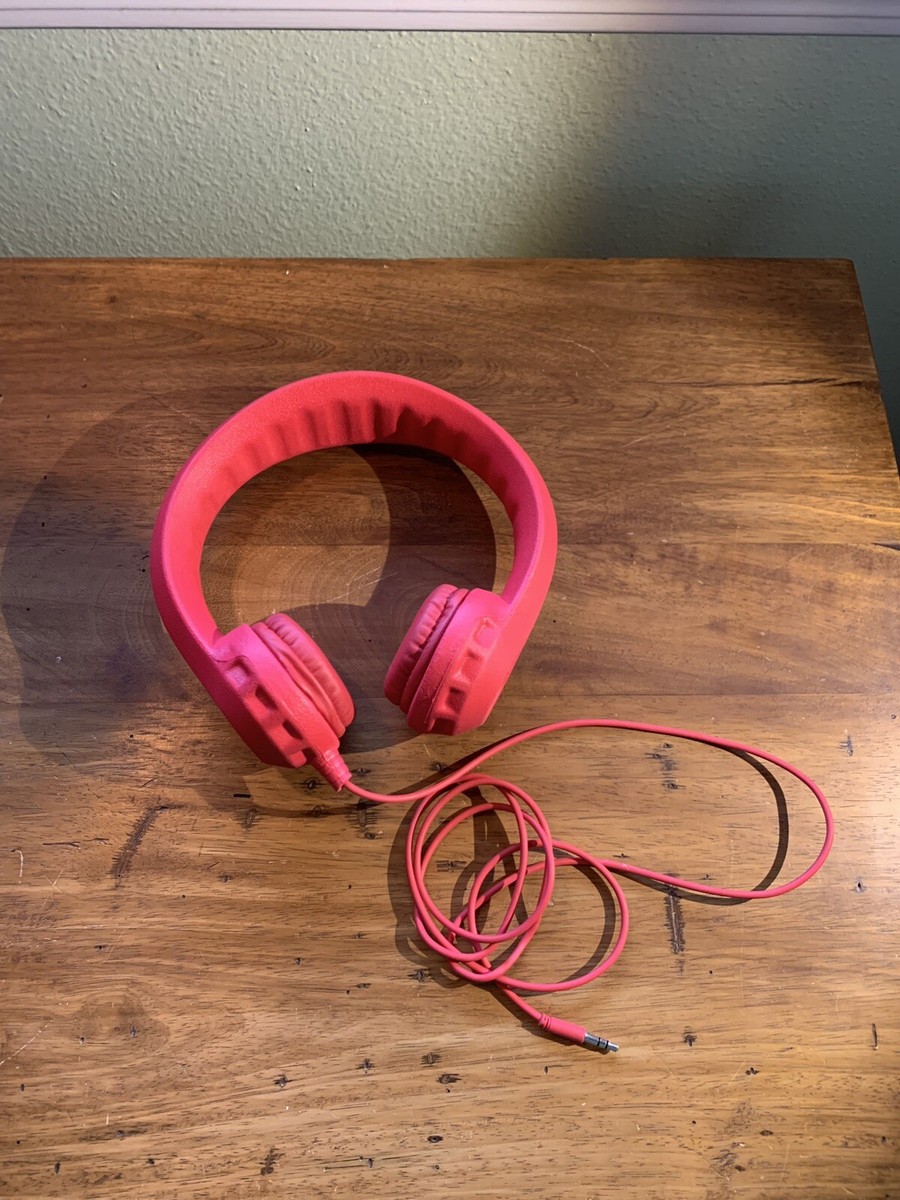
Kidrox Wired Toddler Headphones for 1-7 Years Old, 85dB Volume Limited
Best HeadphonesKidrox · $29.95
Price last checked August 15, 2026 — see Amazon for current pricing.
85dB volume-limited headphones designed for toddler heads, perfect for tablet time on flights.
Pros
- 85dB volume limit protects hearing
- Designed for ages 1–7
- Comfortable fit for small heads
- Works with iPad, tablet, and phones
Cons
- Wired only—no Bluetooth
- Cord can tangle
- May not fit older kids well
If your toddler watches anything on a tablet during flights — and let us be honest, screen time rules get flexible at cruising altitude — the Kidrox headphones are the ones to get. The 85dB volume limit is genuinely enforced, not just a marketing claim. Independent measurements with a decibel meter show they consistently capped output well within the safe range recommended by the World Health Organization for children.
The fit is where these stand apart from generic kids' headphones. Most "kids headphones" are really designed for 5-to-10-year-olds, and they slide right off a 2-year-old's head. The Kidrox are built for ages 1 through 7, with a headband that adjusts small enough for an 18-month-old and ear cups that actually cover toddler-sized ears. On a four-hour flight to Denver, our 2-year-old wore these through two full episodes of Bluey and a 45-minute nap without once pulling them off or complaining.
The wired design is actually a feature, not a drawback. Bluetooth headphones for toddlers introduce pairing hassles, battery anxiety, and one more thing to charge before a trip. A 3.5mm cable plugs in and works. If your iPad has ditched the headphone jack, grab a Lightning or USB-C adapter and toss it in your bag permanently. You will need it eventually.
Best for: Toddlers age 18 months and up who watch tablets on flights. Pair with a tray cover that has a tablet stand and you have a self-contained entertainment station.
2. Alpine Muffy Baby Ear Protection
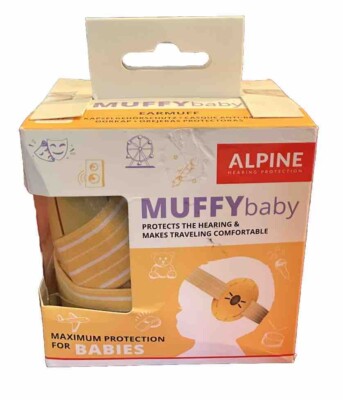
Alpine Muffy Baby Ear Protection for Babies and Toddlers up to 36 Months, CE & ANSI Certified
Best for BabiesAlpine · $30.99
Price last checked August 15, 2026 — see Amazon for current pricing.
CE and ANSI certified earmuffs designed specifically for babies 0 to 36 months with a soft elastic headband.
Pros
- CE and ANSI certified noise reduction
- Soft elastic band won't squeeze baby's head
- Designed specifically for babies
- Improves sleep in noisy environments
Cons
- Babies may try to pull them off
- Headband can slide
- Only up to 36 months
For babies under 18 months, you need ear protection, not headphones. The Alpine Muffy Baby is the standard here, and for good reason. The soft elastic headband does not squeeze or create pressure points the way rigid-band earmuffs do on infant heads. This matters enormously because a baby who is uncomfortable will claw at the earmuffs and scream, which defeats the entire purpose.
The CE and ANSI certifications are real and verifiable. Alpine is a Dutch company that has been making hearing protection for decades — these are not a generic product with a sticker slapped on them. The noise reduction is substantial enough to take the edge off engine noise, which is exactly what you want. You are not trying to create total silence; you are trying to bring the ambient noise down to a level where your baby can relax and sleep.
The specification indicates these work best when you put them on right as you board, before the engine noise ramps up. If you wait until the baby is already overstimulated by engine roar, putting anything on their head becomes a battle. Think of it as preventing discomfort rather than treating it.
One practical tip: the elastic headband can slide if your baby has a smaller head. Some parents thread a soft hair tie through the band to snug it up. Works perfectly.
Best for: Babies 0 to 18 months. Essential for first flights and any flight longer than two hours. Also excellent for baby carrier travel through loud airport terminals.
3. ProCase Noise Cancelling Earmuffs
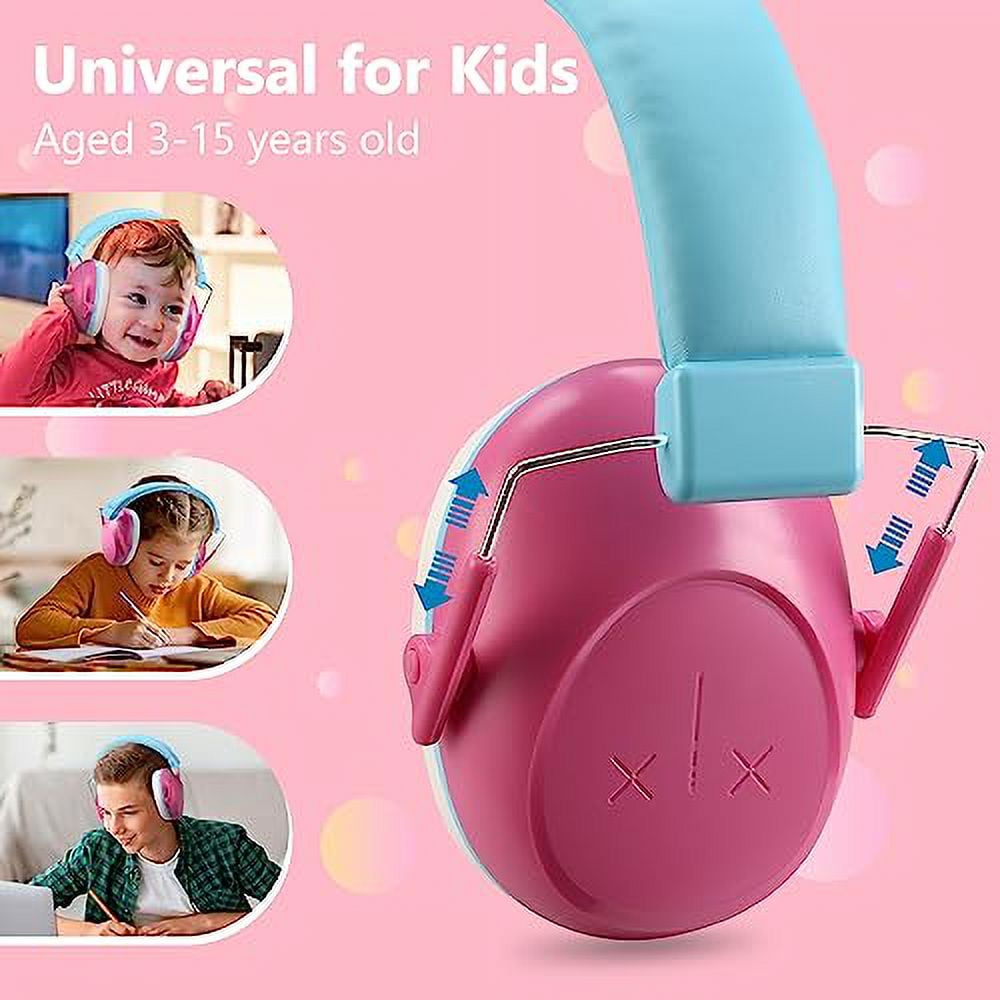
ProCase Noise Cancelling Headphones for Kids, SNR 27dB Noise Reduction Ear Muffs
Budget PickProCase · $9.99
Price last checked August 15, 2026 — see Amazon for current pricing.
Solid 27dB noise reduction at under ten dollars — the best value in kids hearing protection.
Pros
- Under $10—incredible value
- 27dB noise reduction
- Adjustable for growing kids
- Foldable for travel
Cons
- Can feel tight on some heads
- No audio—protection only
- Padding wears over time
At under ten dollars, the ProCase earmuffs are borderline absurd value. They deliver 27dB of noise reduction, which is in the same range as earmuffs costing three or four times as much. The adjustable headband means they grow with your child, and they fold flat for packing.
The trade-off versus the Alpine Muffy is comfort for the youngest kids. The ProCase uses a rigid headband rather than a soft elastic, so they are better suited for toddlers 18 months and up rather than young babies. For a 2-year-old or 3-year-old, though, these are perfectly comfortable and do the job.
These are worth keeping in a permanent airport bag as a backup. They are cheap enough that losing them is not a disaster and fold small enough to cost you no meaningful space. The noise reduction takes just enough edge off engine noise during take-off to let a wound-up toddler settle, which is when it matters most.
Best for: Toddlers 18 months and up as a budget-friendly noise reduction option. Great as a backup pair or for families who fly infrequently and do not want to spend $30 on earmuffs.
Tray and Activity Setup
The airplane tray table is your toddler's workspace for the flight. Getting this setup right is the difference between activities that stay organized and a chaotic mess of crayons, snacks, and tablet cords sliding everywhere. These two products take different approaches — one covers and organizes the existing tray, the other gives your child their own lap-based surface.
4. Lusso Gear Airplane Tray Cover
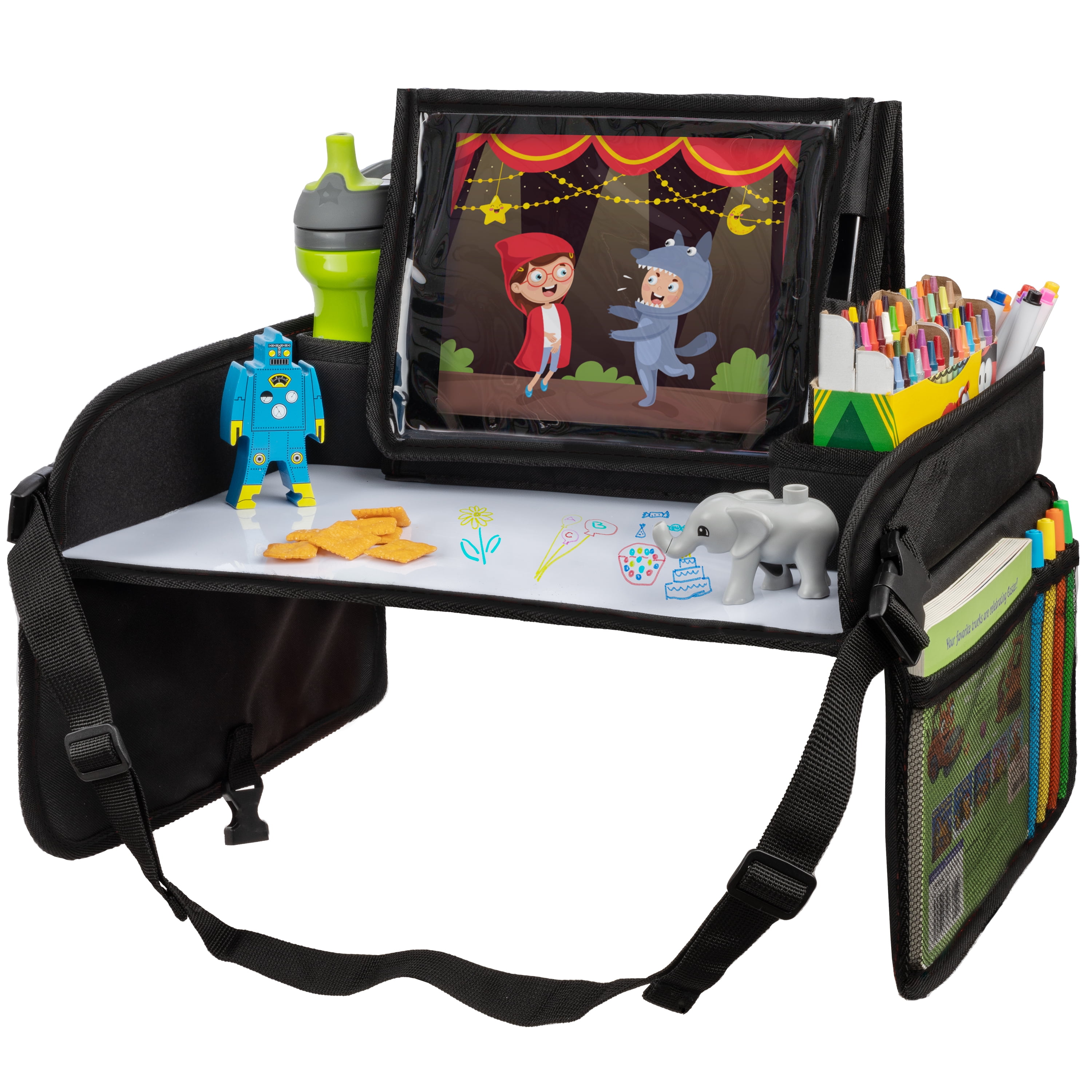
Lusso Gear Airplane Tray Table Cover with Snack & Toy Pockets, Foldable Tablet Stand
Best Tray SetupLusso Gear · $32.99
Price last checked August 15, 2026 — see Amazon for current pricing.
Covers the germy tray table with a clean surface and adds pockets for snacks, toys, and a built-in tablet stand.
Pros
- Creates clean surface over germy tray tables
- Built-in snack and toy pockets
- Foldable tablet stand included
- Fun plane pattern kids love
Cons
- Pricey for a tray cover
- May not fit all tray sizes perfectly
- Pockets are shallow
Let us talk about airplane tray tables for a second. Studies have found them to be among the dirtiest surfaces in the entire aircraft — dirtier than the lavatory flush button in some tests. Your toddler is going to put food directly on that surface, lick it, press their face against it. The Lusso Gear tray cover solves this problem while also solving the organization problem.
The cover wraps around the tray table and creates a clean, washable surface. The pockets on the front hold snacks, crayons, small toys, and a pacifier without them rolling off the tray every time the plane banks. The built-in tablet stand holds an iPad at a watchable angle, freeing up tray space for snacks or activities. After the flight, throw it in the wash.
The main concern is price — at $34, this is a lot for what is essentially a placemat with pockets. But if you fly even twice a year, the hygiene factor alone justifies it. Parents report using it on fifteen-plus flights and it is still in great shape. The plane pattern is a nice touch that gets toddlers excited about setting up "their space" on the plane.
One limitation: it does not fit every single tray table perfectly. Most standard economy trays work fine, but some regional jets have oddly sized trays. It still covers the surface even if it does not wrap perfectly around the edges.
Best for: Any toddler old enough to use the tray table (typically 2 and up in their own seat). Pairs perfectly with the Kidrox headphones for a complete entertainment station.
5. PILLANI Travel Tray
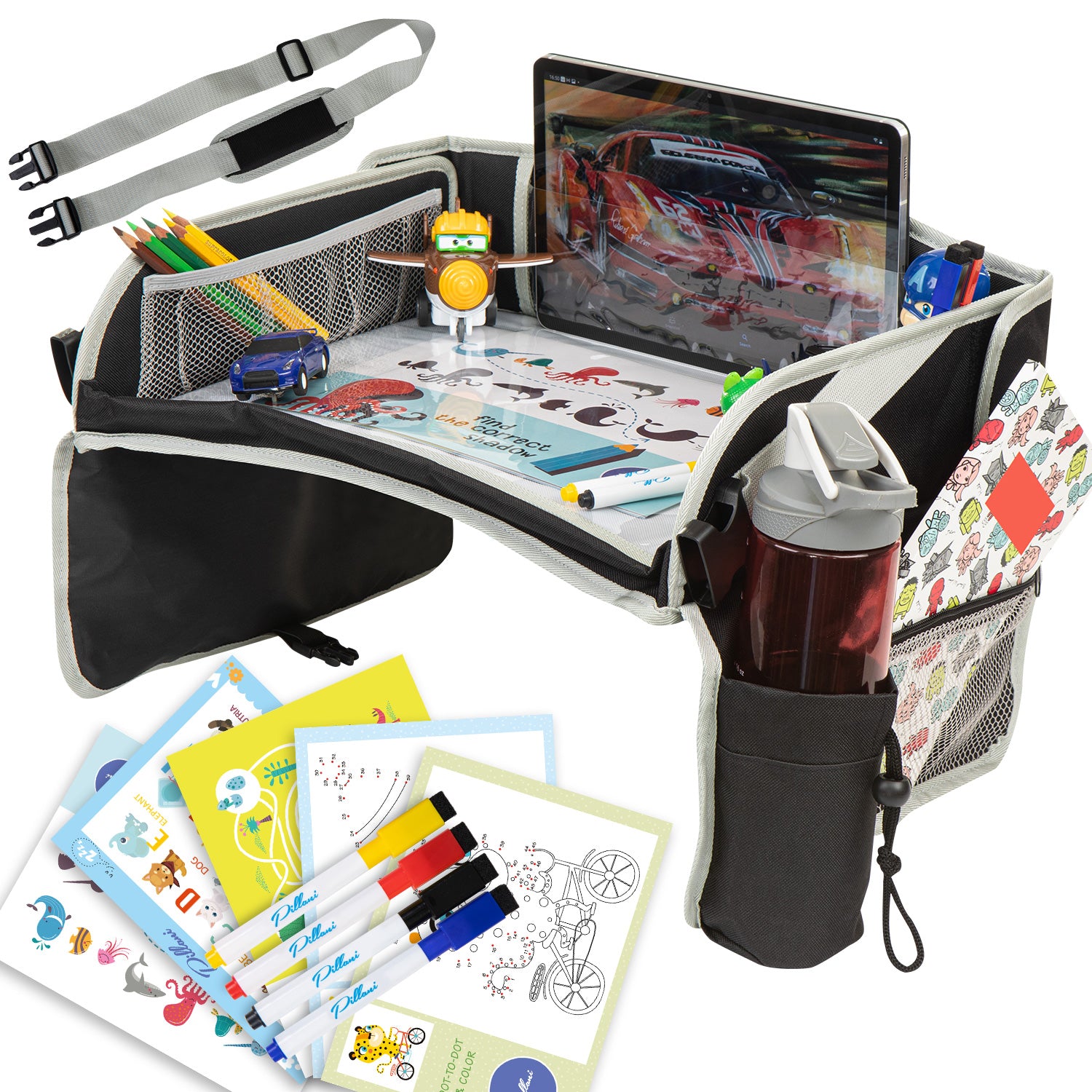
PILLANI Kids Travel Tray for Car & Airplane with Activity Sheets & Pens
Most VersatilePILLANI · $20.89
Price last checked August 15, 2026 — see Amazon for current pricing.
Works as both a lap tray on planes and a car seat tray, and comes with activity sheets and pens.
Pros
- Works in car seats and airplane seats
- Includes activity sheets and pens
- Built-in tablet holder
- Collapsible for packing
Cons
- Can slide off small laps
- Activity sheets are one-time use
- Tablet holder fits limited sizes
The PILLANI takes a different approach. Instead of covering the airplane tray, it gives your toddler a lap-based activity surface that works on planes, in car seats, and anywhere else you need a flat surface for a small child. This is the better option for lap children (under 2) who do not have their own seat and therefore do not have a tray table.
The included activity sheets and pens are a genuine bonus — they provide an immediate activity without you needing to dig through your bag. The tablet holder works with most iPads and tablets, though very large tablets may not fit securely. The whole thing collapses flat for packing, which is critical because carry-on space is already at a premium.
Where this shines is versatility: it works on an aircraft tray table and then again as a car seat activity tray in the hire car, which is what justifies the space it takes in your bag. The raised edges stop small items sliding off — a minor-sounding feature until you have chased a crayon under the seat in front for the third time.
Best for: Lap children under 2 who do not have their own tray table, or families who want a single tray that works on planes and in cars. Remove during takeoff and landing as required by flight crew.
Entertainment
Here is the hard truth about toddler airplane entertainment: no single activity lasts the whole flight. The key is rotation. You need three to five activities that each buy you 15 to 30 minutes, and you introduce them one at a time throughout the flight. These three products are the ones that consistently deliver the best time-per-ounce ratio.
6. Melissa and Doug Water Wow - Under The Sea
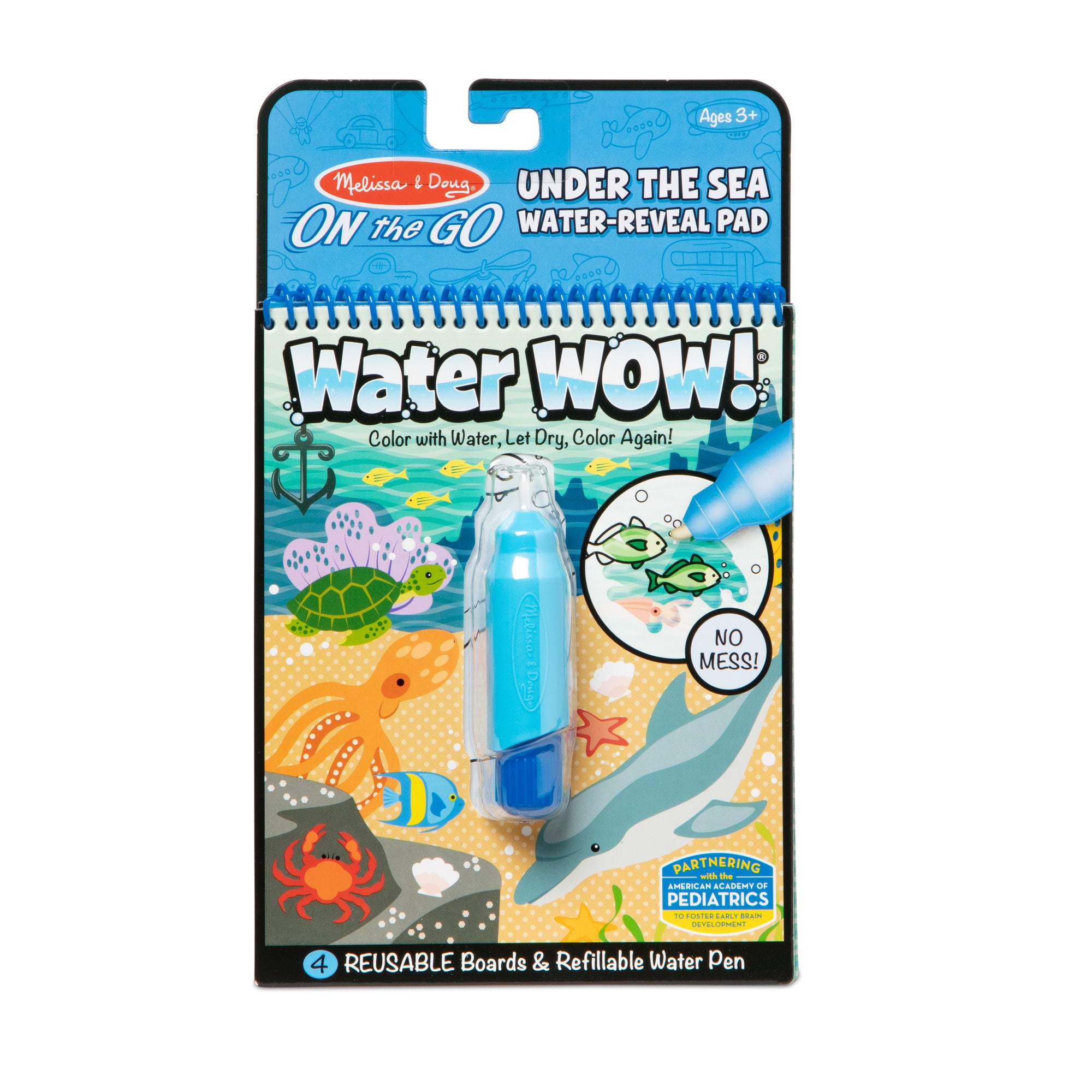
Melissa & Doug On The Go Water Wow! Under The Sea, Reusable Water-Reveal Activity Pad
Best Mess-FreeMelissa & Doug · $8.99
Price last checked August 15, 2026 — see Amazon for current pricing.
Completely mess-free coloring that uses only water. Reusable after drying. Perfect for confined airplane spaces.
Pros
- Completely mess-free—just water
- Reusable after drying
- Under the Sea theme
- Compact and lightweight
Cons
- Only 4 pages
- Water pen can leak in bag
- Young toddlers may lose interest quickly
The Water Wow is the single best airplane activity ever invented for toddlers, and we will defend that statement against all comers. You fill the pen with water. Your child "colors" the pages. Colors appear like magic. The pages dry and can be reused. There is zero mess. No ink, no paint, no stains, no cleanup. On an airplane, where a single spilled cup of juice creates a crisis, this matters more than you can imagine.
The Under The Sea theme is engaging for most toddlers, but Melissa and Doug makes these in about a dozen themes. We recommend buying two or three different ones for a single flight so you can rotate. At $8 each, they are cheap enough to stock up. Our 2-year-old typically gets 15 to 20 minutes per pad, and since they are reusable, you can pull the same one out again later in the flight after it dries.
One important tip: empty the water pen before packing it in your bag. A full pen can leak and soak everything around it. Fill it from your water bottle once you are on the plane and settled.
The official age recommendation is 3+, but parents have used these successfully with kids as young as 18 months. Younger toddlers will not stay in the lines, but they do not care — they just want to see the colors appear.
Best for: Ages 18 months to 4 years. The single best ratio of entertainment time to mess risk on an airplane. Buy multiples.
7. TEKFUN LCD Writing Tablet
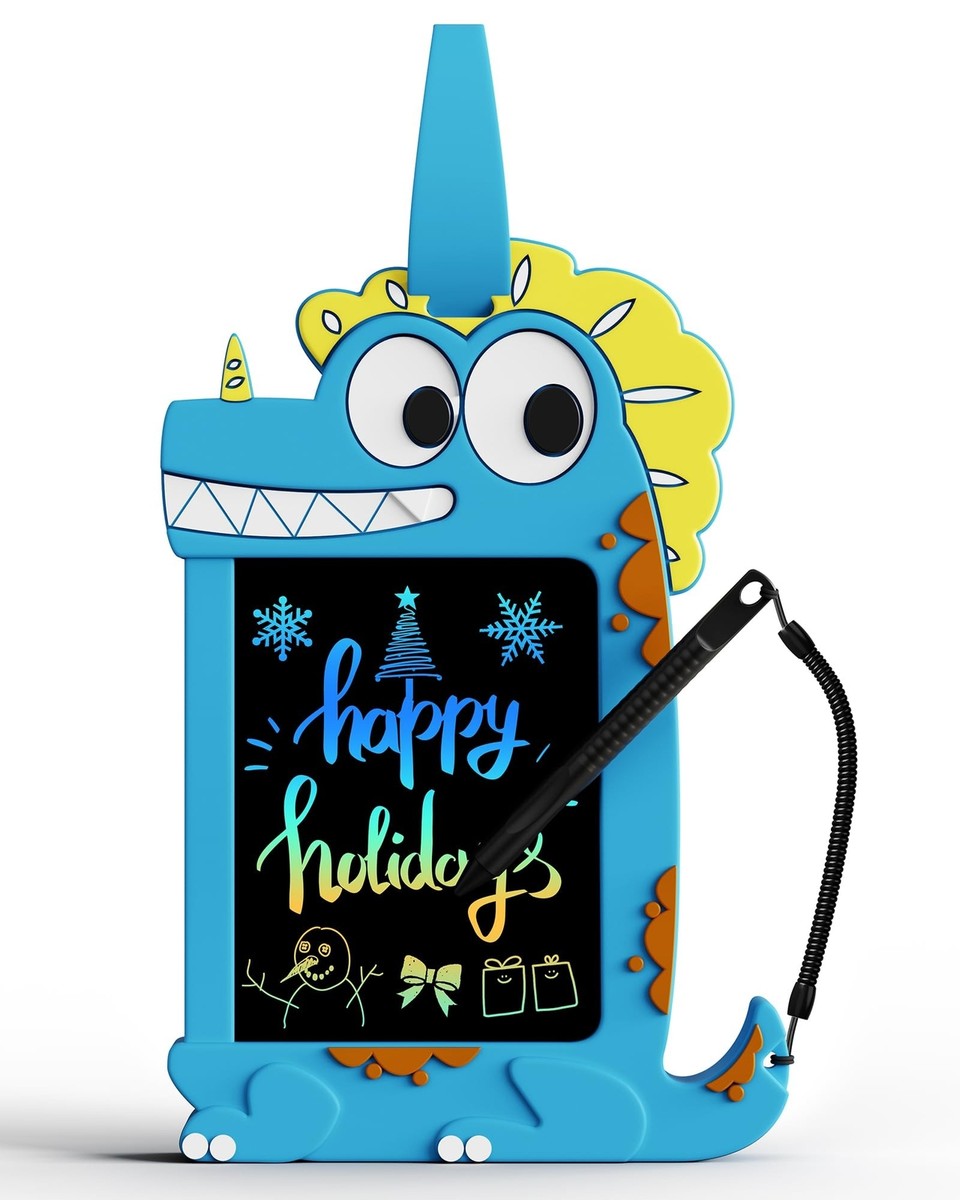
TEKFUN LCD Writing Tablet for Kids, 10-inch Coloring Drawing Pad, Mess Free Doodle Board
Best Screen-FreeTEKFUN · $21.99
Price last checked August 15, 2026 — see Amazon for current pricing.
Ten-inch LCD doodle board that is thin enough for the seat pocket and provides unlimited mess-free drawing.
Pros
- 10-inch colorful screen
- No paper or markers needed
- One-button erase
- Lightweight and thin for seat pocket
Cons
- Can't save drawings
- Screen visibility in bright light
- Stylus can get lost
If your toddler likes to draw, the TEKFUN tablet is the move. It is a 10-inch LCD screen that you draw on with a stylus (or a fingertip), and one button press erases everything. No paper, no markers, no mess. The colorful display keeps things visually interesting, and the thin profile means it fits in the seat pocket.
We initially bought this as a backup activity, and it quickly became a primary one. Our 3-year-old routinely spends 20 to 30 minutes drawing on it during flights, which is an eternity in toddler-on-a-plane time. The draw-and-erase cycle is inherently appealing to toddlers — they love the instant reset and the magic of making their drawings disappear.
The main risk is losing the stylus. Attach it to the tablet with a short piece of string or a lanyard clip before your flight. The built-in stylus slot is fine for home use, but on a plane with turbulence and tiny hands, that stylus will end up under the seat in about four minutes flat without a tether.
The battery lasts essentially forever, and the reason is structural: it is a coin cell that powers only the erase function. The screen itself uses no power to hold an image, so the battery only drains on each wipe.
Best for: Ages 2 to 5+. The best reusable drawing activity for flights. Tether the stylus.
8. Gojmzo Busy Board
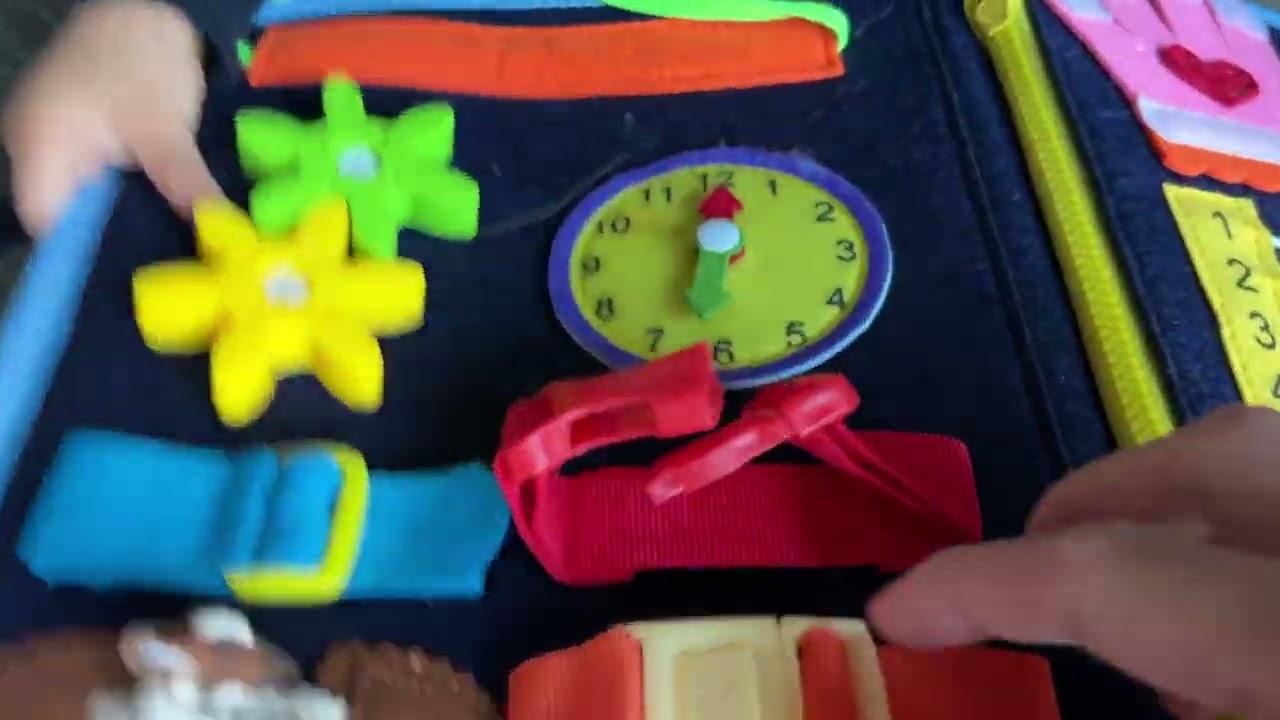
Gojmzo Busy Board Montessori Toys for Toddlers, Busy Book Sensory Toys
Best for Young ToddlersGojmzo · $22.98
Price last checked August 15, 2026 — see Amazon for current pricing.
Montessori-style busy board with zippers, buckles, buttons, and velcro — silent and screen-free.
Pros
- Multiple activities in one book
- Silent—no sounds or batteries
- Develops fine motor skills
- Compact for seat pocket
Cons
- Small pieces can detach
- Velcro wears out over time
- Some activities too easy for older toddlers
For the youngest toddlers — roughly 12 months to 2.5 years — a busy board is the best screen-free entertainment option on an airplane. The Gojmzo board packs multiple Montessori-inspired activities into a compact book format: zippers, buckles, buttons, velcro, snaps, and laces. Every activity is silent, which matters when you are surrounded by other passengers who are trying to sleep on a red-eye.
The developmental angle is real. These activities build fine motor skills — the same skills your toddler needs for eating with utensils, getting dressed, and eventually writing. So you are not just keeping them quiet; you are actually supporting their development. That said, let us be practical: you are buying this because it keeps them occupied for 15 to 25 minutes on an airplane, and it does that reliably.
Check all the pieces before your flight. Some of the velcro elements and small attachments can come loose after repeated use. On an airplane, a detached small piece is both a choking hazard and something that will roll under the seat never to be seen again. We do a quick inspection before every flight and reinforce anything that feels loose with a few stitches or a dab of fabric glue.
The book format is ideal for airplane use — it opens flat on the tray table or on a lap and does not have pieces that extend beyond its footprint. It also fits in a seat pocket, which means your toddler can access it independently.
Best for: Ages 12 months to 30 months. The best screen-free option for young toddlers. Inspect before every flight.
Safety
9. CARES Safety Airplane Harness
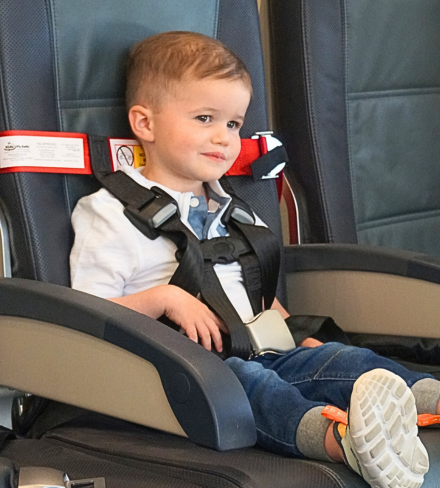
CARES Child Airplane Travel Harness, FAA Approved Safety Restraint System
Safety EssentialAmSafe · $79.99
Price last checked August 15, 2026 — see Amazon for current pricing.
The only FAA-approved harness alternative to bringing a car seat on the plane. Weighs just one pound.
Pros
- Only FAA-approved harness alternative to car seat
- Weighs just 1 lb
- Fits in a small stuff sack
- Easy to install on any airplane seat
Cons
- Only forward-facing
- Limited weight range 22–44 lbs
- Expensive for a harness
- Some flight attendants unfamiliar with it
The CARES harness is the only product of its kind — literally the only FAA-approved airplane harness that serves as an alternative to installing a car seat on the aircraft. If you have been dreading the thought of lugging a 20-pound car seat through the airport, this is your answer. It weighs one pound, fits in a small stuff sack, and installs on any forward-facing airplane seat in about two minutes.
The harness wraps around the airplane seat back and adds an upper-body restraint to the existing lap belt. This keeps your toddler properly positioned in the seat during turbulence instead of being held in place only at the waist by the adult lap belt. For toddlers between 22 and 44 pounds (roughly age 1 to 4 for most kids), this provides meaningful additional safety.
There are two things to know before you buy. First, some flight attendants are not familiar with the CARES harness even though it has been FAA-approved since 2006. We carry a printed copy of the FAA approval letter in the stuff sack with the harness. We have needed it twice in forty-plus flights. Second, the harness only works forward-facing, so it does not replace a rear-facing car seat for younger toddlers. For guidance on when and how to use car seats on planes, see our airline car seat rules guide and our roundup of FAA-approved car seats.
At $83, this is the most expensive item on this list, but consider what it replaces: the hassle and physical burden of carrying a car seat through the airport. If you fly more than once or twice a year with a toddler, the CARES harness pays for itself in preserved sanity almost immediately.
Best for: Toddlers 22 to 44 pounds who have their own seat. The only realistic alternative to bringing a car seat on board. Pair with a travel stroller for the complete lightweight flying setup.
Comfort
10. SAIREIDER Kids Neck Pillow
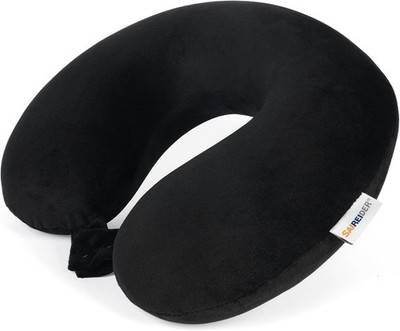
SAIREIDER Travel Neck Pillow, 100% Pure Memory Foam, Soft Adjustable for Plane, Car & Home
Best for NapsSAIREIDER · $9.99
Price last checked August 15, 2026 — see Amazon for current pricing.
Memory foam neck pillow at just ten dollars — helps toddlers sleep upright on planes.
Pros
- 100% memory foam for comfort
- Adjustable fit
- Works in plane and car
- Very affordable at $10
Cons
- May be too large for very small toddlers
- Memory foam retains heat
- Can't be machine washed
Getting a toddler to sleep on an airplane is half the battle of any flight longer than two hours. The SAIREIDER neck pillow is a simple, inexpensive tool that makes a real difference. The memory foam conforms to your child's neck and keeps their head from flopping forward or to the side when they doze off.
At $10, this is an easy addition to your flight bag. The adjustable design means it fits toddlers from roughly 2 years old through early elementary school. It compresses reasonably well for packing, though it does not pack as small as an inflatable pillow. The trade-off is comfort — memory foam is simply more comfortable than an inflatable, and comfort is what determines whether your toddler actually sleeps or wakes up cranky after five minutes.
A practical note on timing: do not put the neck pillow on your toddler at the beginning of the flight. Wait until they show signs of being tired — rubbing eyes, getting fussy, losing interest in activities. Then dim their window shade, put on the earmuffs or headphones with quiet music, position the neck pillow, and create the conditions for sleep. This routine works far better than hoping the pillow alone will knock them out.
The one downside is that memory foam retains heat, so on warm flights or if your child runs hot, the pillow can feel uncomfortably warm. A thin muslin cloth draped over it solves this.
Best for: Toddlers 2 years and up on flights longer than two hours. Most useful for afternoon and evening flights when nap time aligns with the flight.
Age-by-Age Guide: What to Bring on the Plane
Not every product works for every age. Here is what we actually pack based on the age of the child:
0 to 12 Months
At this age, the baby IS the entertainment — and the challenge is mostly about comfort and noise.
- Alpine Muffy Baby ear protection — essential for every flight
- CARES harness — if the baby is over 22 pounds and has their own seat (though most babies this age are lap infants)
- A couple of small sensory toys from home (nothing new — familiar objects are comforting)
- Plenty of milk or formula for feeding during takeoff and landing (the sucking/swallowing helps equalize ear pressure)
Skip the busy boards, Water Wows, and tablets at this age. A baby under 12 months needs comfort, feeding, and sleep support — not activities.
1 to 2 Years
This is the hardest age to fly with. Old enough to want independence but too young for sustained focus on any single activity.
- Alpine Muffy Baby or ProCase earmuffs — depending on head size
- Gojmzo Busy Board — the best screen-free option for this age
- Melissa and Doug Water Wow (2 or 3 different ones) — most toddlers can use these by 18 months
- PILLANI Travel Tray — especially for lap children without their own tray table
- CARES harness — if over 22 pounds and in their own seat
- Small board books and two or three novel small toys they have never seen before
Plan for one new activity every 15 to 20 minutes. Pack more than you think you need.
2 to 4 Years
This is when flying gets easier. Toddlers at this age can engage with structured activities and even watch shows on a tablet.
- Kidrox headphones — for tablet time
- ProCase earmuffs — for noise protection during non-tablet time
- TEKFUN LCD Writing Tablet — for drawing
- Lusso Gear Tray Cover — to set up their activity station
- Melissa and Doug Water Wow — still works great at this age
- SAIREIDER neck pillow — for nap time
- CARES harness — if under 44 pounds
- A loaded tablet with downloaded shows and age-appropriate apps (download everything before you leave home — do not rely on in-flight WiFi)
At this age, most toddlers can handle a three-to-four-hour flight with minimal meltdowns if you have the right gear and rotate activities.
What NOT to Buy: Overhyped Airplane Products
Telling you what to skip matters as much as telling you what to buy. These products appear constantly in "toddler airplane essentials" lists and consistently disappoint the parents who buy them:
Inflatable airplane footrests / leg extenders — These get recommended everywhere, and some airlines explicitly ban them. Even where they are allowed, they create a tripping hazard in the row, make it harder to get in and out of the seat, and most toddlers just kick them or try to stand on them instead of using them as intended. Save your money and your carry-on space.
Bluetooth headphones for toddlers under 3 — The pairing process alone will cost you five minutes of sanity at a moment when you have none to spare. Batteries die at the worst possible time. And a disconnected Bluetooth headphone on a toddler who was mid-show is a meltdown trigger. Wired headphones are more reliable in every way that matters on an airplane.
Suction cup toys for airplane windows — These work on smooth surfaces. Airplane windows are often textured or curved in a way that breaks the suction. Your toddler will spend more time picking them up off the floor than playing with them on the window.
Sticker books with tiny stickers — Tiny stickers end up on the seat, the tray, the window, the floor, the person sitting next to you, and your toddler's face. Cleanup is a nightmare. If you want stickers, bring the large reusable kind that stick to a single sheet, not the peel-and-stick-everywhere type.
Travel-sized play dough — It sounds mess-free. It is not. Tiny pieces end up ground into the seat fabric, and you will be picking dried play dough out of the seat crack while the entire plane waits for you to deplane. Leave it at home.
Airplane Entertainment Bag Packing Checklist
Pack a dedicated entertainment bag that fits under the seat in front of you (not in the overhead bin where you cannot reach it during the flight). Here is what goes in it:
- Headphones (Kidrox or equivalent volume-limited wired headphones)
- Ear protection (Alpine Muffy for babies, ProCase for toddlers)
- Tablet with shows and apps downloaded (charge fully before leaving home)
- Tablet charger and cable
- Headphone adapter (Lightning or USB-C to 3.5mm if needed)
- Tray cover or lap tray
- 2 to 3 Water Wow pads (pens EMPTY — fill on the plane)
- LCD writing tablet with stylus tethered
- Busy board (for toddlers under 2.5)
- Neck pillow
- CARES harness in its stuff sack
- 3 to 4 individually wrapped snacks (the unwrapping is part of the entertainment)
- 1 to 2 small novel toys they have not seen before (dollar store finds work great)
- Change of clothes for the child in a zip-lock bag
- Empty sippy cup (fill after security)
- Pacifier and backup pacifier
Pack items in the order you plan to use them — things for takeoff on top, sleep supplies lower down, landing activities at the bottom.
Pro Tips From 40+ Flights With Toddlers
Board last, not first. Airlines offer priority boarding for families. Ignore it. Every minute you board early is another minute your toddler has to sit in a confined space. Let your partner board with the bags during priority, and you board last with the child. Less time on the plane equals less time you need to fill.
Window seat, always. The window gives your toddler something to look at during takeoff and landing when activities have to be stowed. It also means they cannot escape into the aisle. Bulkhead seats give you more floor space but no seat pocket and no window view — we will take a standard window seat every time.
The snack rotation is as important as the activity rotation. Individually wrapped snacks — raisins, crackers, fruit pouches — serve double duty as both food and entertainment. The unwrapping process itself occupies small hands for several minutes. Do not dump everything out at once. One snack at a time, spaced throughout the flight.
Download content before you leave home. Do not rely on in-flight WiFi for streaming. Most in-flight WiFi cannot handle video streaming reliably, and even when it works, the connection drops regularly. Download episodes of your toddler's favorite shows to the tablet's local storage. Netflix, Disney+, and YouTube all allow downloads for offline viewing.
Manage ear pressure during descent. Toddler meltdowns during descent are often caused by ear pressure, not boredom. Have your child drink from a sippy cup, eat a snack, or use a pacifier during the last 20 minutes of the flight. The swallowing motion helps equalize pressure in the eustachian tubes. Bring ear protection for the noise, but also bring something that promotes swallowing for the pressure.
Dress your toddler in layers. Airplane cabins fluctuate between uncomfortably warm during boarding and frigid at cruising altitude. A base layer plus a zip-up fleece gives you options. Avoid complicated outfits with lots of buttons — you may need to change clothes quickly in a tiny lavatory.
Use a travel stroller at the gate. Even if your toddler walks fine, a stroller at the gate keeps them contained and gives you hands free for bags. Gate-check the stroller at the jet bridge door — it will be waiting when you deplane. Check out our guide to the best travel strollers for flying for options that make the airport easy.
The first 15 minutes set the tone. When you sit down, get your toddler settled immediately. Ear protection on, first activity out, snack ready. If the first 15 minutes go well, the flight usually goes well. If you spend the first 15 minutes wrestling with bags in the overhead bin while your toddler spirals, you are playing catch-up for the rest of the flight.
Individual Reviews
We have written in-depth reviews for several products in this roundup. Each review includes detailed testing, comparisons, and our honest take after months of real-world use.
Disclosure: ToddlerTravelGear is reader-supported. We may earn a commission if you buy through links on our site — at no extra cost to you. Learn more
Frequently Asked Questions
Products Mentioned
Kidrox
Kidrox Wired Toddler Headphones for 1-7 Years Old, 85dB Volume Limited
Read review →
Alpine
Alpine Muffy Baby Ear Protection for Babies and Toddlers up to 36 Months, CE & ANSI Certified
Read review →
ProCase
ProCase Noise Cancelling Headphones for Kids, SNR 27dB Noise Reduction Ear Muffs
Read review →
Lusso Gear
Lusso Gear Airplane Tray Table Cover with Snack & Toy Pockets, Foldable Tablet Stand
Read review →
PILLANI
PILLANI Kids Travel Tray for Car & Airplane with Activity Sheets & Pens
Read review →
Melissa & Doug
Melissa & Doug On The Go Water Wow! Under The Sea, Reusable Water-Reveal Activity Pad
Read review →
TEKFUN
TEKFUN LCD Writing Tablet for Kids, 10-inch Coloring Drawing Pad, Mess Free Doodle Board
Read review →
Gojmzo
Gojmzo Busy Board Montessori Toys for Toddlers, Busy Book Sensory Toys
Read review →
AmSafe
CARES Child Airplane Travel Harness, FAA Approved Safety Restraint System
Read review →
SAIREIDER
SAIREIDER Travel Neck Pillow, 100% Pure Memory Foam, Soft Adjustable for Plane, Car & Home
Read review →
Related Content
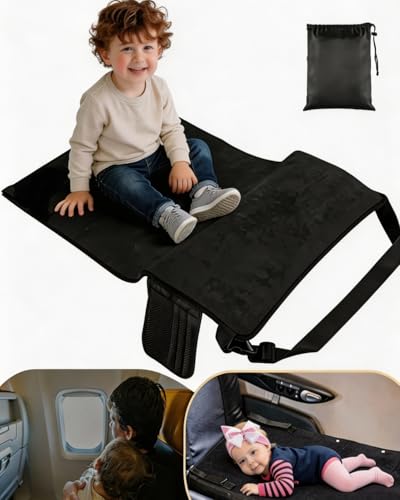
SkyCradleNap Toddler Airplane Bed: Read the Airline Rules First
A spec-led look at the SkyCradleNap toddler airplane bed: under 1 lb, 55 lb limit, and the airline-policy problem that decides whether it is usable at all. $25.99.
Lusso Gear Airplane Tray Cover Review: A Clean Surface and Activity Station in One
Honest Lusso Gear airplane tray cover review — snack pockets, toy pockets, foldable tablet stand, and a clean surface over germy tray tables. $32.99.
Flying with a Toddler: The Complete Parent's Guide (2026)
Complete guide to flying with a toddler — booking seats, packing carry-ons, and surviving meltdowns at 35,000 feet. Real parent advice.