Pumping and Breastfeeding When You Fly: Airport and In-Flight Guide
How to bring a breast pump and milk through TSA, find an airport lactation room, nurse or pump on the plane, and keep milk cold on a long travel day.
You can bring a breast pump, pumped milk and the ice packs that keep it cold through US airport security, with or without your baby on the trip. Milk in any amount is allowed in your carry-on once you declare it. Large and medium hub airports must have a private lactation room past security in every terminal. On board you can nurse at your seat or pump with a battery-powered pump. Milk keeps for up to 24 hours in an insulated cooler with frozen ice packs, which covers most travel days.
Quick answers
- Pump: allowed in carry-on and checked bags.
- Milk: more than 3.4 oz is allowed in your carry-on. Tell the officer and screen it separately.
- Ice packs: allowed even when you are not carrying milk yet.
- Lactation rooms: required past security at large and medium hub airports, and at some small hubs.
- Cooler time: up to 24 hours with frozen ice packs, per the CDC.
For the step-by-step screening process, see our TSA rules for baby food, formula and breast milk. This page covers the rest of the day: the pump, the lactation room, the flight and the cooler.
Can you bring a breast pump on a plane?
Yes. The TSA's breast pump page allows breast pumps in both carry-on and checked bags. As with every item, the final decision rests with the officer at the checkpoint. Pack the pump in your carry-on if you will need it before you reach your destination, or if losing it would leave you without a way to pump. Checked bags can be delayed, and you can't replace pump parts easily on arrival. If the bag holding your pump is large, ask your airline whether it counts toward your carry-on allowance.
Do you need to take the pump out at security?
The TSA does not list a pump as an item you must unpack. The milk is what you must declare and remove for separate screening. Put your pump parts in a clear bag on top so you can lift them out if an officer asks.
Can you carry breast milk without your baby?
Yes. The TSA's breast milk page says your child does not need to be with you to bring breast milk, formula or related supplies. That matters if you are traveling for work and pumping to keep your supply up, or bringing milk home. Quantities over 3.4 ounces (100 ml) are allowed and do not need to fit in a quart-sized bag. Tell the officer at the start of screening and take the milk out of your bag. The TSA recommends clear bottles, because milk in bags or pouches may not fit its bottle scanners and you may be asked to open them.
What if you do not want your milk X-rayed?
Tell the officer. The TSA says its X-ray machines do not harm food, but if you decline X-ray or opening, it will clear the milk another way and you will go through additional screening, which can include a body scan and a closer check of your carry-on bags. Leave extra time if you choose this. The TSA also says screening will never include placing anything into the milk.
Are ice packs and coolers allowed through security?
Yes. The TSA allows ice packs, freezer packs and frozen gel packs needed to cool breast milk in carry-on bags, "regardless of the presence of breast milk." So you can bring frozen packs to the airport for milk you will pump later. If a pack has partly melted and is slushy, it gets the same screening as the milk itself.
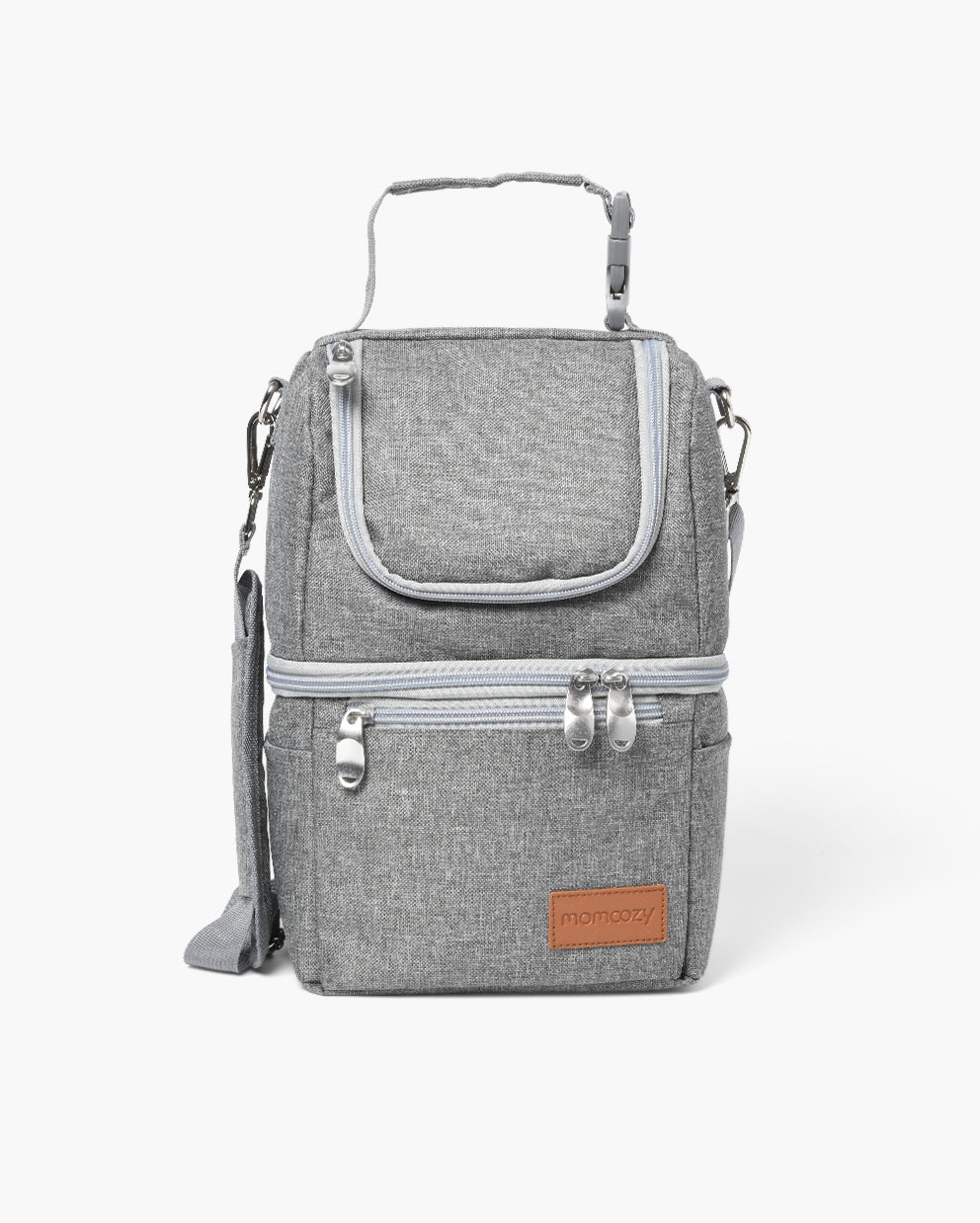
A cooler built for milk saves space. The Momcozy breast milk cooler holds 22 oz in two bottles and uses a cooling tube you freeze ahead, rated by Momcozy for up to 24 hours. Our travel feeding and bottles roundup compares other options.
Can you use dry ice?
In checked bags, only within limits. The TSA's dry ice page says the FAA limits you to 5.5 pounds of dry ice that is properly packaged in a vented package and marked, and airline approval is required. For a single travel day, frozen gel packs are simpler.
How long does breast milk last on a travel day?
The CDC's breast milk storage guidance sets these limits for freshly pumped milk:
| Where the milk is | How long it keeps |
|---|---|
| Room temperature (77°F or colder) | Up to 4 hours |
| Insulated cooler with frozen ice packs | Up to 24 hours when traveling |
| Refrigerator | Up to 4 days |
| Freezer | About 6 months is best; up to 12 months is acceptable |
Once milk is warmed or brought to room temperature, use it within 2 hours, and use a partly finished bottle within 2 hours. Never refreeze milk that has fully thawed. The CDC's travel advice adds that if frozen milk still has ice crystals when you arrive, you can refreeze it. Label each bottle with the date and time you pumped it.
Where can you pump or nurse at the airport?
At large and medium hub airports, in a lactation room past security. Federal law (49 U.S.C. 47107(w)) makes federal airport grants to these airports conditional, since fiscal year 2021, on keeping a lactation area in the sterile area of each passenger terminal building, plus a baby changing table in at least one men's and one women's restroom per terminal. The same rule has applied to qualifying small hub airports since fiscal year 2023. The airport's website usually lists where the rooms are.
What does an airport lactation room have to include?
Under the same law, a lactation area must be shielded from view and free from intrusion by the public, have a door that locks, and include a place to sit, a table or other flat surface, a sink or sanitizing equipment, and an electrical outlet. It must be accessible to people who use wheelchairs and cannot be in a restroom. Smaller airports are not covered, and the FAA can allow a room outside security for a time during construction, so check before you fly from a regional airport.
Can you breastfeed anywhere in the terminal?
Yes. The National Conference of State Legislatures reports that all 50 states, the District of Columbia, Puerto Rico and the Virgin Islands have laws permitting women to breastfeed in any public or private location. You do not need to use the lactation room to nurse your baby. The room is mainly useful for pumping, which takes longer, needs an outlet and is easier with a door and a flat surface.
Can you breastfeed on the plane?
Yes, at your seat. Nursing during takeoff and descent can also help your baby's ears: the CDC recommends nursing during takeoff and landing to help protect against ear pain from cabin pressure changes. If your baby is a lap infant, a nursing cover or a top that opens easily makes this simpler in a narrow seat. A window seat gives you a wall on one side. Our flying with a baby guide covers seat choice, car seats and ear pressure for the first year.
Can you pump on the plane?
Usually, yes, but plan to run on battery. Power outlets vary by aircraft and seat, and some planes have USB power only or none at all. A battery-powered or wearable pump avoids that problem. Airlines set their own rules on using electronic devices on board, so check with your airline if you are unsure, and avoid pumping during taxi, takeoff and landing, when you need to stay seated and belted.
You can pump at your seat with a cover, or in the lavatory if you prefer privacy, though lavatories are small and may be busy during service. Bring a clean bag for used parts and wipes for cleaning until you can wash them properly.
What about spare pump batteries?
The FAA's lithium battery rules say spare lithium batteries and power banks must travel in carry-on bags only, with terminals protected from short circuits. If a carry-on bag is gate-checked, take the spare batteries out and keep them with you in the cabin. The simplest approach is to keep the pump, its battery and any power bank together in the bag under your seat.
Should you put breast milk in a checked bag?
Only if you have to. The TSA allows breast milk in checked bags, but a checked bag sits in the hold for hours, can be delayed and is outside your control, while milk in a cooler with you can be topped up with fresh ice. Carry the milk you need for the trip and any you cannot afford to lose. If you are bringing home a large frozen supply, a dedicated hard cooler in checked baggage can work; plan the ice, label the cooler, and ask your airline about any rules.
What about international flights?
The TSA's rules cover screening at US airports only. On the way home, or on any connection abroad, the airport's own security rules apply, and limits on liquids, milk without a baby, ice packs and dry ice differ by country. Check the security rules of each airport on your route and the entry rules of your destination. Ask your airline about rules for pumping and power on board, as these differ too. Our airport guide for parents covers timing and layovers.
Travel-day checklist for pumping parents
- Pump, all parts, a spare set of valves and membranes, and a charging cable
- Fully charged pump and spare batteries, in your carry-on
- Insulated cooler with ice packs frozen solid before you leave home
- Clear bottles for milk you will carry through security
- Labels or a marker for the date and time
- Lactation room locations for each airport on your route
- A nursing cover or easy-access top for the flight
How we assessed this: This guide is based on TSA, CDC and FAA guidance, the US Code and NCSL's state law tracking, checked October 2026, plus the manufacturer's specifications for the cooler linked. We have not tested these products. Airline policies on pumps, bags and electronics vary, so check yours.
Disclosure: ToddlerTravelGear is reader-supported. We may earn a commission if you buy through links on our site — at no extra cost to you. As an Amazon Associate, we earn from qualifying purchases. Learn more
Frequently Asked Questions
Products Mentioned
Related Content

TSA Rules for Formula, Breast Milk and Baby Food (2026)
TSA lets you carry formula, breast milk, toddler drinks and baby food over 3.4 oz. How to declare them, what screening involves, and ice pack rules.
Can You Bring It Through TSA? Baby and Toddler Items A–Z
Formula, pouches, wipes, diaper cream, medicine, car seats, power banks and Play-Doh: the TSA rule for each baby and toddler item, linked to its source.
Navigating Airports With a Toddler: Security, Gate-Checking and Layovers
How TSA screens toddlers, what happens to the stroller and car seat, gate-checking basics, layover timing, and keeping a toddler safe curb to plane.