Gate Check or Counter Check Your Stroller? How to Decide
When to keep the stroller to the gate, when to check it with your bags, how gate-checking works step by step, and what to do if it comes back damaged.
If your child still rides in the stroller, gate-check it. You keep it through security, the terminal and any layover, and it spends less time in the airport's baggage system than a stroller checked with your suitcases. Counter-checking makes more sense for a bulky full-size or jogging stroller, for a child who walks well or rides in a carrier, and for trips where you want the stroller packed in a padded bag and out of your hands from the start. Your airline sets the details, so read its stroller policy before you fly.
Quick verdict
- Gate-check it if your toddler naps or rides in the stroller, you have a connection or a long walk to the gate, or you are flying alone with your child.
- Counter-check it if the stroller is heavy or oversized, you plan to use a carrier in the airport, or you are flying nonstop and won't need it until you land.
- Ask about the cabin if it is a compact stroller that folds close to carry-on size. Whether it goes in the overhead bin is the airline's decision on the day.
- In every case: strip off accessories, label the frame, and report any damage before you leave the airport.
What is the difference between gate-checking and counter-checking?
Counter-checking means handing the stroller over at the check-in desk with your suitcases. It travels through the airport's baggage system, rides in the hold, and you collect it at baggage claim or the oversized-baggage area. Gate-checking means you push the stroller through security and the terminal, get a tag at the departure gate, and leave it at the aircraft door or the end of the jet bridge. It still rides in the hold, but it skips the conveyor belts, and on many flights it comes back at the aircraft door. The AAP's HealthyChildren.org notes that strollers generally aren't counted as luggage, but airline policies change often, so confirm before you book.
When does gate-checking make more sense?
Whenever you will use the stroller inside the airport. A few situations make it the clear choice:
- Your child is under about 3. A toddler who naps on the move or can't walk a long concourse needs somewhere to sit. The stroller is also a safe place to park them while you deal with boarding passes or a restroom stop.
- You have a connection. A layover with a toddler is far easier with wheels. Ask the gate agent whether the stroller will come back at the aircraft door at your connecting airport. If it is tagged through to your final destination, you won't have it between flights.
- The airport is big. Long walks, trains between concourses and gates far from security all favor keeping the stroller.
- You are the only adult. One stroller with the diaper bag in the basket is easier than a child on your hip and a bag on each shoulder.
When does counter-checking make more sense?
When the stroller costs you more effort in the terminal than it saves. That is usually true of:
- Full-size, jogging and double strollers. They are awkward to fold at the security belt, and some airlines set size or weight limits on what they accept at the gate. Check your carrier's rules for doubles in particular.
- Children who walk well or ride in a carrier. A four-year-old who will walk to the gate, or a baby in a carrier, may not need the stroller until baggage claim.
- Nonstop flights to a waiting car or rental stroller. If you won't use it at either airport, checking it early means one less thing to manage at security.
Counter-checking means more handling, so it calls for more protection. A stroller going through the full baggage system belongs in a padded bag, not a thin drawstring cover.
Decision table: gate check or counter check?
| Your situation | Usually the better choice | Why |
|---|---|---|
| Toddler under 3, connecting flight | Gate check | You have the stroller in both terminals and your child can nap in it |
| Large hub airport or long walk to the gate | Gate check | Saves carrying a child the whole way |
| Child who walks well, or a baby in a carrier | Counter check | One less item through security |
| Full-size, jogging or double stroller | Counter check in a padded bag | Bulky at the belt; gate limits may apply |
| Compact stroller that folds near carry-on size | Ask about the cabin, otherwise gate check | The airline decides on the day |
| Expensive stroller, nonstop flight | Gate check in a bag, or counter check padded | Gate-checking means less handling; a padded bag covers counter-checking |
| Solo parent with a toddler | Gate check | The stroller carries the bags as well as the child |
How does gate-checking work, step by step?
- Before the trip, read your airline's stroller and family-travel page for size limits, doubles and any fees. Label the frame with your name and phone number, and practice the fold.
- At security, TSA requires strollers, umbrella strollers, baby carriers and car seats to go through the X-ray machine. Anything too large for the machine gets a visual and physical inspection instead. Take your child out and carry them through the metal detector (TSA, Traveling with Children).
- At the gate desk, ask for a gate-check tag and attach it to the stroller frame, not to a removable part or the bag.
- At boarding, push the stroller down the jet bridge. Take off cup holders, organizers and rain covers, empty the basket, fold it, slip it into its bag and leave it where the crew directs.
- On arrival, ask the crew before you get off where gate-checked items are returned. If it is the aircraft door, wait on the jet bridge. If it is baggage claim, have a carrier ready.
Our airport guide covers the rest of the day, from security to layovers.
Where does a gate-checked stroller come back?
At the aircraft door or at baggage claim, depending on the airline, the airport and sometimes the aircraft. There is no single federal rule for this, and the same airline may return strollers differently at different airports. Ask at the gate desk when you get your tag, and ask the crew again before landing. If you won't see the stroller until baggage claim, the walk from the gate can be a long one with a tired toddler, so keep a baby carrier in your carry-on as a backup.
Empty the basket: what not to leave in a gate-checked stroller
Treat the basket as checked baggage. The FAA's lithium battery rules say that when a carry-on bag is checked at the gate or planeside, every spare lithium battery and power bank must come out of it and stay with you in the cabin. A power bank tucked in a stroller organizer is the easiest one to forget. Take out medicine, phones, keys and anything fragile too. The DOT's baggage guidance warns against packing valuables, medicine and fragile items in luggage that could be checked at the gate.
Can a compact stroller go in the overhead bin instead?
Sometimes. A few cabin-fold strollers fold close to carry-on dimensions, and some airlines accept them in the overhead bin. That is the airline's decision, it usually counts against your cabin allowance, and on a full flight the crew can still send it to the hold. There is no such thing as an FAA-approved stroller. The FAA approves child restraints for use in flight, meaning car seats labeled for aircraft and the CARES harness (FAA Kids' Corner). A stroller is never used during taxi, takeoff or landing. A listing that calls a stroller "FAA-approved" is talking about its folded size. Our travel strollers for flying roundup compares folded dimensions against common cabin limits. Pack a gate-check bag either way.
Do you need a gate-check bag or a padded bag?
It depends on where the stroller goes. A gate-checked stroller spends little time in the baggage system, so a thin drawstring bag that keeps grease and rain off it covers the most likely damage. The J.L. Childress gate check bag is a budget example, bright red and easy to spot when strollers come up from the hold. A stroller checked at the counter travels with suitcases, so padding earns its weight. The J.L. Childress padded stroller bag has padding in the body and a pocket sized for a tracker. If you add a tracker, the FAA's battery chart allows trackers in checked baggage only within small lithium limits, so check yours. The stroller travel bags roundup compares bags for doubles and joggers.
What should you do if the stroller comes back damaged?
Report it before you leave the airport. The DOT's Lost, Delayed, or Damaged Baggage page says to report any problems to the airline before leaving the airport, insist on a written report, and note the date, time and name of the person you spoke with. It also says:
- Airlines are responsible for repairing or reimbursing damage that happens while a bag is under their control, up to federal liability limits.
- Airlines are not responsible for pre-existing damage or damage caused by improper packing.
- On domestic flights, airlines can exclude certain items, such as fragile items, in their contracts of carriage. Read your airline's stroller damage policy before you fly.
Take photos of the stroller before you hand it over so you can show its condition. If the airport baggage office doesn't resolve the claim, write to the airline's consumer office. DOT requires airlines to acknowledge a complaint within 30 days and respond in writing within 60 days. If that fails, you can file a complaint with DOT.
What about the car seat at the gate?
If your child has a purchased seat and the car seat carries the aircraft label, take it on board. If an approved seat doesn't fit in the assigned spot, the FAA says the airline must find another seat in the same class for it (FAA Kids' Corner). If you are not using it on the plane, HealthyChildren.org notes that gate-checking a car seat can help prevent damage and usually costs nothing extra, but check with your airline. A car seat needs its own bag; see the J.L. Childress car seat travel bag review. Our airline car seat rules guide covers labels, fit and installation.
Gate-check checklist
- Read your airline's stroller policy, especially for doubles and joggers.
- Label the stroller frame with your name and phone number.
- Photograph the stroller at home.
- Pack the gate-check bag where you can reach it.
- Ask for the tag at the gate desk and fix it to the frame.
- Empty the basket: power banks, medicine, phones and valuables come with you.
- Ask where the stroller will come back, at the gate and again before landing.
- Inspect it at the door or baggage claim and report damage before leaving.
For everything else on flight day, see our complete guide to flying with a toddler.
How we put this together
This guide draws on published guidance from the TSA, the FAA, the US Department of Transportation and the AAP's HealthyChildren.org, linked above. We have not tested the bags or strollers mentioned. Gate-check rules differ by airline, so confirm them with your carrier.
Frequently Asked Questions
Products Mentioned

Related Content
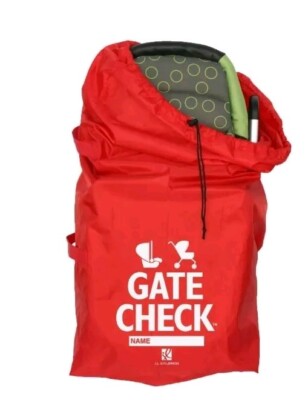
J.L. Childress Gate Check Bag: What a Budget Stroller Bag Does and Doesn't Do
The J.L. Childress gate check bag keeps grease and rain off a stroller at the jet bridge. What fits, why it is not for checked bags, and when to pay more.
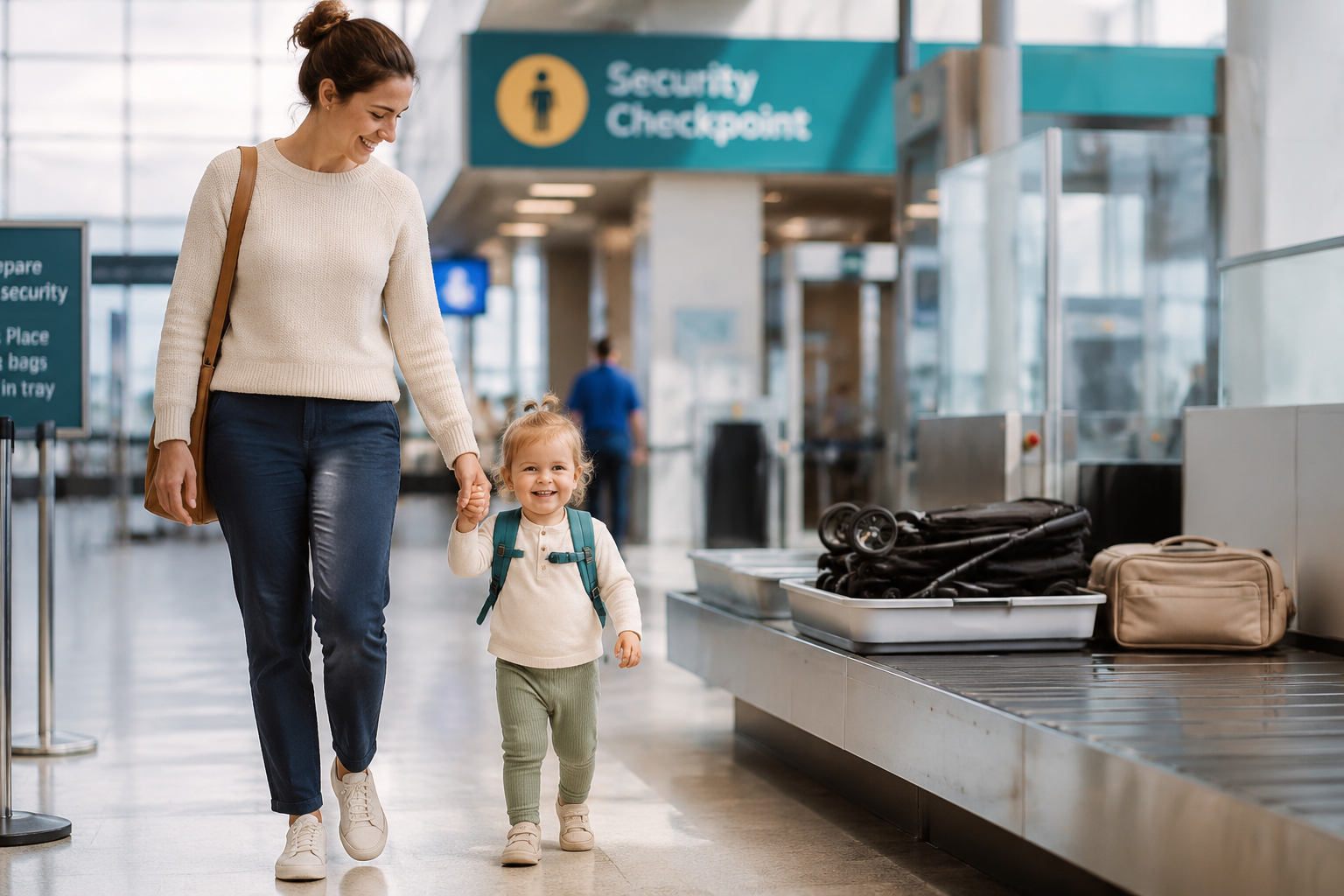
Flying Alone With a Toddler: A Solo Parent's Plan
How to fly solo with a toddler: booking flights and seats, packing one bag, getting through security alone, lavatory trips, connections and documents.
Can You Bring It Through TSA? Baby and Toddler Items A–Z
Formula, pouches, wipes, diaper cream, medicine, car seats, power banks and Play-Doh: the TSA rule for each baby and toddler item, linked to its source.