Disclosure: ToddlerTravelGear is reader-supported. We may earn a commission if you buy through links on our site — at no extra cost to you. Learn more
MAMAZING Ultra Air Review: The Carbon Fiber Stroller That Weighs Less Than a Bowling Ball
Honest MAMAZING Ultra Air review — carbon fiber frame, 11.5-pound weight, airport testing, and ride quality after 7 months of travel use.
The moment I picked up the MAMAZING Ultra Air for the first time, I thought there was a mistake. I lifted it off the shipping box and my arm overshot — the stroller weighed so little that the force I expected to need for a twenty-pound stroller launched an eleven-pound stroller toward the ceiling. Carbon fiber will do that. It is the same material used in racing bicycles and aircraft components, and MAMAZING has used it to build a stroller frame that weighs roughly the same as a gallon of milk.
We bought the Ultra Air because our previous travel stroller — a perfectly good aluminum-frame compact stroller that weighed 17 pounds — had started to feel heavy after three consecutive airport trips where we carried it through terminals, down jet bridge stairs, and back up stairs at the destination. Six extra pounds does not sound like much. After carrying it one-handed through Dallas Fort Worth's Terminal C while also managing a carry-on, a toddler, and a melting ice cream cone my daughter refused to relinquish, six pounds felt like sixty. The MAMAZING Ultra Air at $199.99 promised to cut the weight in half. It delivered.
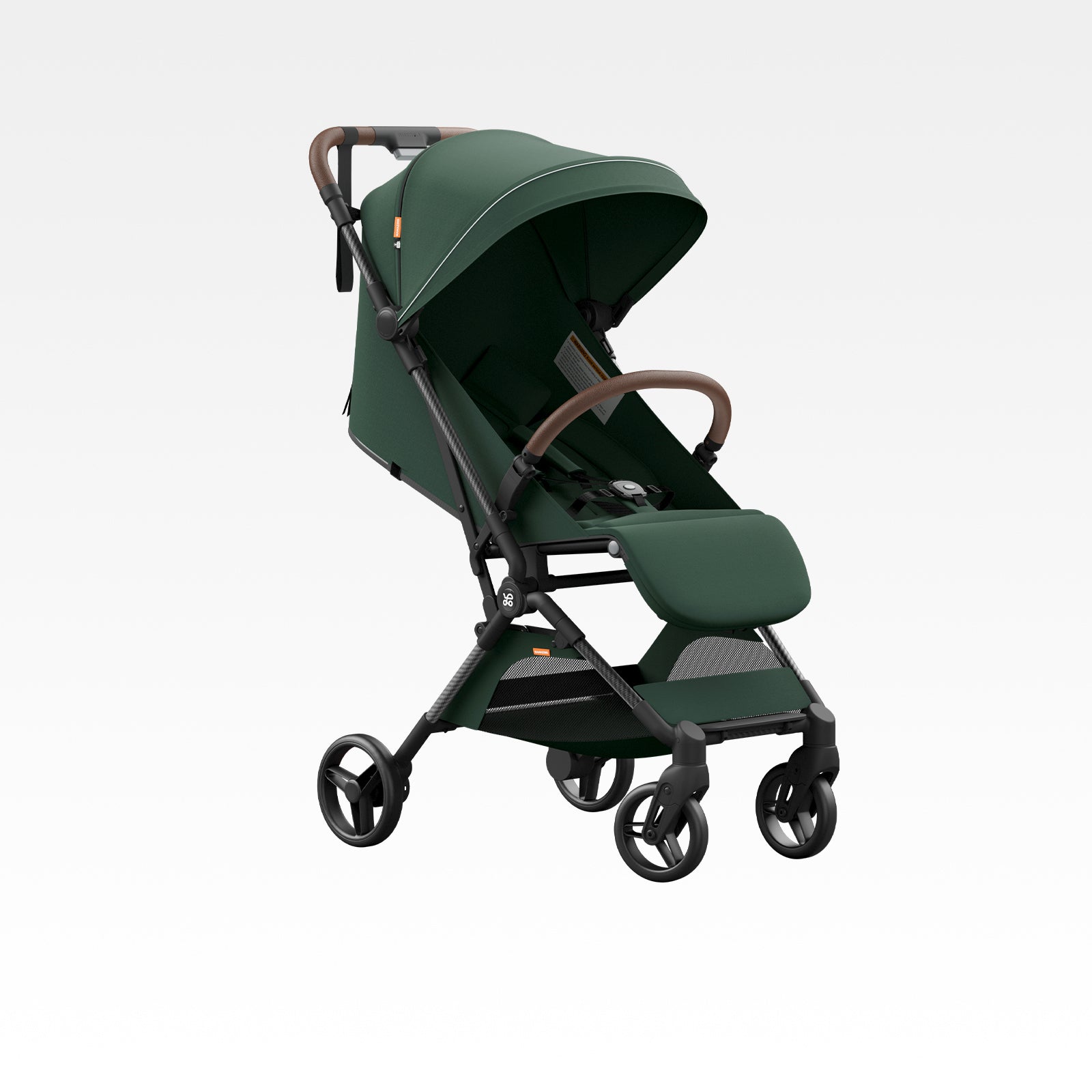
MAMAZING Ultra Air Lightweight Baby Travel Stroller with Carbon Fiber Frame
Ultralight PickMAMAZING · $199.99
Price may vary
Carbon fiber frame at just 11.5 pounds — the lightest full-featured travel stroller we have tested. $199.99 for airport-day freedom.
Pros
- Ultra-lightweight at 11.6 lbs
- Carbon fiber frame
- One-handed fold
- Airplane-friendly size
Cons
- Premium price for brand
- Less brand recognition
- Small storage basket
This product is featured in our Best Travel Strollers for Flying roundup.
Quick Verdict
The MAMAZING Ultra Air is the lightest full-featured travel stroller we have used. At approximately 11.5 pounds with the carbon fiber frame, it is lighter than most laptop bags. The weight savings are not theoretical — you feel them every time you lift the stroller into a trunk, carry it down stairs, or sling it over your shoulder in an airport. The stroller folds compactly (not quite as small as a Stokke YOYO3, but close), has a decent canopy, a functional recline, and surprisingly smooth steering for its weight class.
At $199.99, it sits in the mid-range between budget compact strollers ($80-$100) and premium travel strollers ($400-$550). The carbon fiber frame justifies the premium over budget options but does not deliver the build refinement or fold compactness of premium options. The stroller makes the most sense for parents who prioritize weight above all other factors — families who carry their stroller as much as they push it.
Who This Is For
- Airport-heavy families — the 11.5-pound weight makes carrying through terminals, up stairs, and down jet bridges effortless
- Parents with shoulder or back issues — every pound matters when you are lifting a stroller in and out of cars multiple times a day
- Public transit families — light enough to carry one-handed on stairs and escalators while holding your child with the other hand
- Active travel families — the ultralight weight means the stroller does not slow you down during all-day sightseeing
Who Should Skip
- Parents who need maximum fold compactness — the Ultra Air folds smaller than most strollers but not as compact as the YOYO3 or GB Pockit; overhead bin fit is not guaranteed
- Families who want a stroller that lasts five-plus years — the carbon fiber is strong but the overall build quality suggests a three-to-four-year useful lifespan
- Parents who need heavy-duty storage — the underseat basket is minimal, holding a small bag at most
- All-terrain families — the lightweight build and small wheels are designed for pavement, not trails
Key Features Deep Dive
Carbon Fiber Frame
Carbon fiber is a composite material that is significantly lighter than aluminum while maintaining comparable strength. The MAMAZING Ultra Air uses carbon fiber for the main frame tubes, which is what drives the weight down to 11.5 pounds. For context, most aluminum-frame travel strollers weigh 13 to 17 pounds, and steel-frame strollers weigh 18 to 25 pounds.
The weight difference is immediately noticeable. Picking up the Ultra Air feels like picking up a folding chair. Lifting it into a car trunk is a one-finger operation. Carrying it through an airport with the included shoulder strap feels like carrying a light messenger bag. After seven months of use, the weight has never been a factor in any decision about whether to bring the stroller — it is always worth bringing because bringing it costs nothing in effort.
The carbon fiber is also stiffer than aluminum, which contributes to the stroller's responsive steering. There is less frame flex when turning or pushing at speed, which translates to a more direct, precise feel through the handlebar. The trade-off is that carbon fiber is more susceptible to impact damage than aluminum — a sharp hit to the frame tube (like dropping it on a concrete edge) could potentially crack the carbon fiber, where aluminum would dent but remain functional. We have not experienced any frame damage in seven months, but we handle it more carefully than we would an aluminum stroller.
Fold and Portability
The Ultra Air folds with a two-step process: release the seat, then collapse the frame. The folded dimensions are approximately 22 x 19 x 9 inches — compact enough for most car trunks and airline gate-checking, but slightly larger than the YOYO3's folded footprint. We have fit it in overhead bins on Boeing 737s and Airbus A321s, though the fit is tighter than with more compact-fold strollers. On some aircraft, it requires the bin to be relatively empty.
The included shoulder strap attaches to the folded stroller and allows you to carry it like a large bag. At 11.5 pounds, the shoulder carry is comfortable for extended walks through airports — we have carried it the full length of Denver International's Concourse B (which feels like a half-marathon) without shoulder fatigue.
Canopy and Sun Protection
The canopy is a three-panel design with UPF 50+ protection and a mesh peek-a-boo window. Extended fully, it covers from head to about mid-torso — adequate for most sun angles but not as deep as premium strollers like the YOYO3 or Bugaboo Butterfly. A pull-out visor extends coverage slightly for low-angle sun.
The canopy fabric is lightweight to maintain the stroller's overall weight target, which means it flutters in strong wind more than heavier canopy fabrics. On a breezy day at the San Diego waterfront, the canopy blew back from its extended position several times. Not a dealbreaker, but noticeable.
Seat and Harness
The seat is a breathable mesh fabric over a structured frame. The mesh promotes airflow, which is a genuine advantage for summer travel and warm-climate destinations — our daughter sweated noticeably less in the Ultra Air than in our previous stroller with a solid fabric seat. The seat width accommodates toddlers comfortably up to about age three and a half, after which broader-shouldered kids may feel snug.
The five-point harness adjusts easily and holds securely. The buckle is straightforward for parents to operate and too complex for our two-year-old to figure out. The shoulder straps include light padding that prevents the rubbing some budget strollers inflict on bare shoulders in summer outfits.
What We Love
The weight changes how you travel. We did not expect 11.5 pounds to feel transformatively different from 17 pounds. It does. The stroller gets lifted in and out of the car without thinking about it. It gets carried up stairs without bracing. It gets slung over a shoulder at the airport without shoulder strap dread. The cumulative effect across a full travel day — trunk to terminal to gate to plane to rental car to hotel — is that the stroller never becomes a burden. It is always worth bringing, which means we always have it when we need it.
The steering is surprisingly precise. Ultralight strollers often steer like shopping carts — the lack of weight means there is nothing to keep the wheels tracking straight, and every sidewalk crack deflects the front wheels. The Ultra Air's carbon fiber frame rigidity compensates for the low weight, providing responsive, direct steering that does not wander. One-hand steering works reliably on smooth surfaces, which matters when your other hand is holding a coffee, a phone, or a toddler's dropped snack.
The breathable mesh seat is a summer savior. On a 92-degree day in Phoenix, our daughter sat in the Ultra Air for a twenty-minute walk between the hotel and a restaurant. When we lifted her out, her back was slightly warm but not sweaty. In our previous stroller, the same walk would have produced a sweat-soaked back and an irritable toddler. For warm-climate travel, the mesh airflow is a genuine comfort feature.
$199.99 is reasonable for carbon fiber. Carbon fiber products typically command steep premiums. A carbon fiber bicycle frame costs $1,000 or more. Carbon fiber luggage starts at $500. A carbon fiber stroller frame at $199.99 feels like a value relative to the material cost, and it delivers on the primary promise — dramatic weight reduction — in a way that meaningfully improves the travel experience.
What We Don't Love
The fold is not the smallest. For an ultralight stroller at $200, we expected a fold that would rival the YOYO3. It does not quite get there. The folded Ultra Air is slightly larger in every dimension, which means overhead bin fit is less reliable. On two of our flights, the overhead bin was already partially full and the stroller did not fit — we gate-checked on those flights. If guaranteed overhead bin storage is a priority, the YOYO3's more compact fold is the safer bet.
The basket is an afterthought. The underseat basket on the Ultra Air is so shallow and narrow that calling it a basket feels generous. A small clutch diaper bag fits. A water bottle fits if laid on its side. Anything more and you are out of luck. The weight savings had to come from somewhere, and the basket appears to be where the engineers stopped adding material. A backpack is mandatory.
Carbon fiber requires careful handling. We are more cautious with this stroller than we would be with an aluminum frame. Sharp impacts — dropping it on concrete, a baggage handler throwing it — could potentially damage the carbon fiber in a way that compromises structural integrity without being visibly obvious. Aluminum dents and keeps working. Carbon fiber can develop internal cracks. We have not had any issues, but the awareness that the frame is less forgiving than metal changes how we handle it.
The ride is firm on rough surfaces. The combination of light weight and small wheels means less vibration dampening on rough pavement. The stroller transmits sidewalk cracks, manhole covers, and uneven paving more directly than heavier strollers with more suspension. On smooth surfaces, the ride is fine. On rough surfaces, it is noticeably bumpy. Our daughter naps in it on smooth sidewalks but stays awake on rough ones.
Real-World Testing
Airports and flights (8 flights): The Ultra Air is outstanding in airports. The 11.5-pound weight makes the gate-to-plane transition the easiest of any stroller we have used. Shoulder-carry through terminals, one-hand fold at the jet bridge, quick gate-check when overhead bins are full. On six of eight flights, we stowed it overhead. On two, we gate-checked per FAA guidelines. Zero damage in either case over seven months.
City sightseeing (multiple trips): Full-day sightseeing in San Diego, Nashville, and Savannah. The lightweight frame made all-day pushing effortless — after eight hours of walking in San Diego, our arms were tired from carrying the toddler, not from pushing the stroller. The stroller navigated boardwalks, sidewalks, restaurant entries, and museum floors without issue.
Curb transitions and thresholds: The small wheels handle standard curb cuts and door thresholds well. Stepping up a curb requires tipping the front wheels up, which is easier with a lighter stroller than a heavier one. The 11.5-pound weight means the tip-and-push curb maneuver is effortless.
Durability (7 months): After seven months of regular travel use (two to four times per month, plus flights), the frame shows no damage, the fold mechanism operates smoothly, and the fabric is in good condition. The wheels show wear patterns consistent with normal use but roll true. The handlebar has maintained its rigidity. So far, the carbon fiber construction has proven durable for our use pattern.
How It Compares
vs. Stokke YOYO3 ($499): The YOYO3 is heavier (13.6 pounds vs. 11.5 pounds), folds more compact, has better build refinement, and has a proven multi-year durability track record. The Ultra Air is lighter, cheaper, and offers comparable ride quality. If fold compactness and long-term build quality are priorities, the YOYO3 wins. If weight and value are priorities, the Ultra Air wins. The 2.1-pound weight difference is noticeable when carrying but irrelevant when pushing.
vs. Ingenuity 3Dquickclose ($95.99): The 3Dquickclose is half the price and folds similarly compact. The Ultra Air is 3.5 pounds lighter, steers more precisely thanks to the carbon fiber frame stiffness, and has a better canopy. For families where every pound matters (shoulder injuries, petite parents, long airport walks), the Ultra Air's weight savings justify the price premium. For families who simply want an affordable compact folder, the 3Dquickclose is the better value.
vs. Bugaboo Butterfly ($449): The Butterfly is heavier (about 16 pounds) with better ride quality, a larger canopy, and a more generous basket. The Ultra Air is nearly 5 pounds lighter, which makes a meaningful difference in carry scenarios. The Butterfly is the better all-around stroller; the Ultra Air is the better carry-through-the-airport stroller. Different priorities, different answers.
MAMAZING Ultra Air Lightweight Baby Travel Stroller with Carbon Fiber Frame
$199.99by MAMAZING
Best For
- ✓Ultra-lightweight at 11.6 lbs
- ✓Carbon fiber frame
- ✓One-handed fold
Prices are accurate as of the date/time indicated and are subject to change. As an Amazon Associate we earn from qualifying purchases.
Final Verdict
The MAMAZING Ultra Air Lightweight Stroller does one thing better than almost any other travel stroller on the market: it disappears when you carry it. The 11.5-pound carbon fiber frame is light enough that the stroller never becomes a factor in your travel decisions. You bring it because it costs nothing in effort. You carry it because it weighs nothing on your shoulder. You fold it and store it because it takes up nothing in your trunk or the overhead bin.
The compromises — smaller basket, firm ride on rough surfaces, careful handling requirements, fold slightly larger than the YOYO3 — are the cost of that weight reduction. For families who push their stroller more than they carry it, those compromises may matter more than the weight savings. For families who carry their stroller through airports, up subway stairs, in and out of rental cars, and across hotel lobbies, the weight is everything. And at $199.99 — less than half the price of a YOYO3 — the Ultra Air delivers on its primary promise at a price that respects your budget.
Frequently Asked Questions
Products Mentioned
Related Content
Graco GoMax Travel System Review: The All-in-One That Covers Newborn Through Toddlerhood
Honest Graco GoMax travel system review — car seat and stroller combo tested across airports, city streets, and road trips.
Ingenuity 3Dquickclose Review: The Sub-$100 Compact Stroller That Folds Ridiculously Small
Honest Ingenuity 3Dquickclose CS+ review — ultra-compact fold, lightweight frame, airport and city testing after 6 months.
Doona Car Seat & Stroller Review: Is the $650 All-in-One Actually Worth It?
Honest Doona review after a year of travel — instant car-to-stroller transition, airport testing, rideshare reality, and more.