Disclosure: ToddlerTravelGear is reader-supported. We may earn a commission if you buy through links on our site — at no extra cost to you. Learn more
Magna-Tiles microMAGS Review: The Best STEM Toy We've Packed for Travel
Honest Magna-Tiles microMAGS 26-Piece review, hotels, and restaurants — mini tile quality, magnet strength, travel case, and more. $19.50.
Full-size Magna-Tiles are one of the most consistently recommended toys for this age group, and the reason is straightforward: the play is open-ended, it absorbs children for long stretches, and it does not generate the conflict that competitive or rule-based toys do. What they are not is portable — a 100-piece set lives in a bin in the living room. The microMAGS are Magna-Tiles' answer to that: smaller tiles, a built-in case, and the explicit aim of putting the same play into an airplane cabin, a hotel room or a restaurant booth.
This page covers what the smaller format does well, where it falls short against the full-size set, and exactly who should buy it.
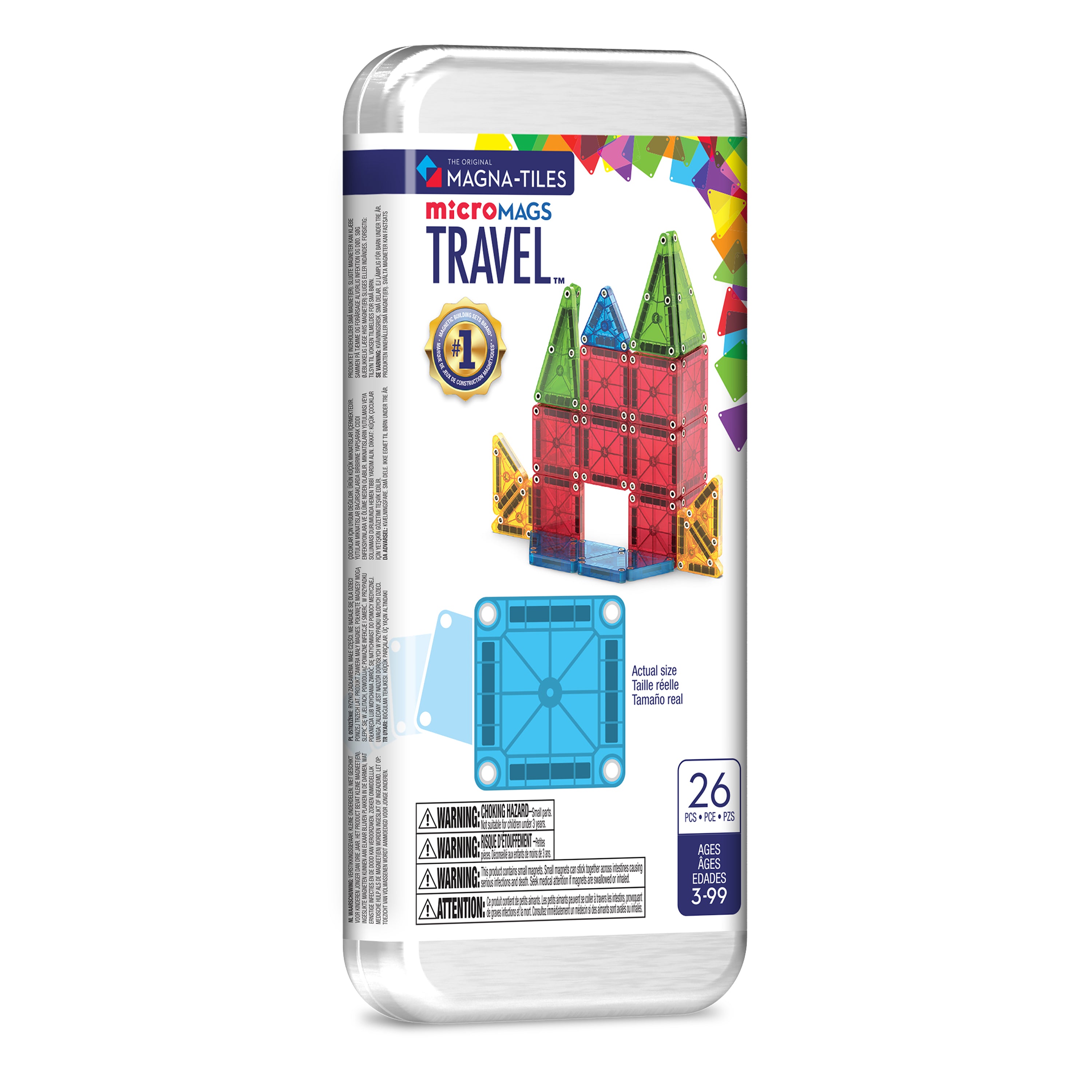
Magna-Tiles microMAGS 26-Piece Travel Magnetic Construction Set
Best STEM Travel ToyMagna-Tiles · $19.50
Price last checked August 15, 2026 — see Amazon for current pricing.
Original Magna-Tiles quality in a travel-sized format with strong magnets, bold colors, and a compact case that fits in any carry-on or diaper bag.
Pros
- Original Magna-Tiles brand quality
- Travel-sized pieces
- Encourages creative building
- Strong magnets hold well
Cons
- Only 26 pieces in travel set
- Small pieces can get lost
- Premium price for size
This product is featured in our Best Travel Toys & Activities roundup.
How we assessed this
We have not personally tested this product. This assessment is built from the manufacturer's published specification, the safety standards the product is certified against, and comparison with the alternatives in its category. Where a question can only be answered by handling the product — how a fabric feels, whether a mechanism stiffens after a year — we say so rather than guess. Full methodology: How We Research.
Quick Verdict
The Magna-Tiles microMAGS are genuinely impressive for their size. The magnets are surprisingly strong for miniaturized tiles, the colors are vivid, and the snap-together satisfaction that makes full-size Magna-Tiles so addictive translates well to the smaller format. Twenty-six pieces is enough for one child to build small structures for 20 to 45 minutes, which is a remarkable amount of quiet, focused play for a travel toy. The built-in case keeps everything contained, and the whole set weighs almost nothing.
That said, these are not full-size Magna-Tiles. The smaller tiles require slightly more dexterity, the piece count limits what you can build, and the price per piece is higher than a standard set. Children under three will struggle with the size and should not use them due to small parts. But for kids three and up who already love magnetic tiles, this is one of the best travel toys we have ever packed.
Who This Is For
The microMAGS are designed for a specific traveling family. Here is who will get the most value.
Great fit:
- Families with kids aged 3 to 7 who already enjoy magnetic building tiles at home
- Parents looking for a screen-free, open-ended activity for flights and restaurants
- Anyone who values STEM learning toys over passive entertainment
- Families who fly frequently and need a compact toy that earns its carry-on space
Not the best fit:
- Families with children under 3 (small pieces are a choking hazard, and the dexterity requirement is too high)
- Parents looking for a toy that entertains for hours without interaction (magnetic tiles are active play, not passive)
- Kids who have never used magnetic tiles before (start with full-size at home to build familiarity first)
- Families who need to entertain multiple children simultaneously (26 pieces is barely enough for one builder)
Who Should Skip
- Parents of children under 3 — The small tiles are a choking hazard and require more fine motor dexterity than most two-year-olds have, leading to frustration rather than fun
- Families looking for passive entertainment — Magnetic tiles are active, hands-on play that requires engagement, not a set-it-and-forget-it toy like a tablet or a movie that buys you an hour of hands-free time
- Parents who need to entertain multiple kids at once — Twenty-six pieces is barely enough for one builder, and splitting the set between two children means neither has enough tiles to create anything satisfying
- Budget-conscious families who want maximum piece count — At roughly $0.77 per tile, the microMAGS cost significantly more per piece than a standard full-size set, and pieces will get lost during travel
Key Features Deep Dive
Mini Size: Smaller Than You Expect
The first thing you notice when you open the microMAGS is how small the tiles actually are. If you are used to the standard 3-inch Magna-Tiles squares, these are noticeably smaller — roughly 1.5 inches per side for the squares. That is about the size of an adult's thumbnail to first knuckle. The triangles, diamonds, and other shapes are proportionally reduced.
This size reduction has real consequences for play. On the positive side, the miniaturized tiles are perfect for confined spaces. They fit on an airplane tray table without hanging over the edge. A small hotel room nightstand becomes a building surface. A placemat at a restaurant is more than enough space. You can build a respectable tower or house without needing a large flat floor area.
On the negative side, smaller tiles are harder for small hands to manipulate. A three-year-old comfortable with full-size Magna-Tiles will still need a few sessions to adjust: separating tiles that have stuck together takes more finger strength, and placing one precisely on a growing structure takes more fine motor control. Most children get there, but expect an initial frustration period rather than an immediate transfer of skill.
The small size also means that individual tiles are easier to lose. A full-size Magna-Tile dropped on an airplane floor is easy to spot. A microMAGS tile can slide under a seat, into a seat crack, or into the abyss of the airplane seat pocket. We will discuss strategies for keeping track of pieces later, but this is a real consideration.
Magnet Strength: Better Than Expected
This was our biggest concern before purchasing. Would miniaturized tiles have weak, disappointing magnets? The answer is no. Magna-Tiles clearly invested in maintaining magnet quality at the smaller scale. The microMAGS tiles click together with a satisfying snap that feels proportionally similar to the full-size experience. Structures hold together well. A tower of six to eight tiles stays upright on a level surface, and you can carefully pick up small builds by the top tile without them falling apart.
The magnets also rotate correctly within the tile housing, which is the hallmark of genuine Magna-Tiles engineering. Unlike cheap knockoffs where some edges repel each other, every edge of every microMAGS tile connects to every edge of every other tile. This sounds like a minor detail, but it eliminates an entire category of toddler frustration. Your child never picks up a tile and has it push away from the structure instead of snapping on. That consistent, reliable connection is a big part of why Magna-Tiles keep kids engaged where lesser brands cause meltdowns.
We did notice that the magnetic attraction does not reach as far as full-size tiles. With standard Magna-Tiles, you can hold a tile about a half-inch away and feel it pull toward the structure. With microMAGS, the attraction range is shorter — you need to get the tiles closer together before the magnetic pull engages. For practiced builders this is a non-issue, but for younger kids still developing precision, it means more deliberate placement is required.
Travel Case: Functional but Basic
The microMAGS come in a compact carrying case that doubles as the packaging. It is a small, sturdy box with a magnetic closure that keeps the tiles contained during travel. The case fits easily into a diaper bag side pocket, a carry-on bag, or even a large jacket pocket.
The case does its job: tiles go in, the lid closes magnetically, tiles do not spill everywhere inside your bag. In months of travel, we have never had the case pop open spontaneously. The magnetic closure is firm enough to survive being jostled in a bag but easy enough for a child to open independently.
What the case is not: a play surface, an organized storage system, or particularly elegant. The tiles just pile in loosely. There are no compartments or dividers. When you open the case, you dump everything out and start building. When you are done, you scoop everything back in. This is fine for travel — any additional organization would add bulk and complexity. But if you are the type of parent who likes sorted, compartmentalized toy storage, the jumble of tiles in the case may bother you.
What We Love
- The magnets are the real deal. Magna-Tiles did not cut corners on the miniaturization. Tiles snap together reliably, structures hold, and there are zero repelling edges. The build quality justifies the brand premium.
- Basically weightless in your bag. The entire set weighs just a few ounces. In the carry-on optimization game where every ounce matters, the microMAGS take up negligible weight and space for the entertainment value they provide.
- Completely silent. No beeping, no music, no electronic sounds. The soft click of magnetic tiles connecting is genuinely pleasant. Nobody on the airplane will glare at you, and the people at the next restaurant table will not even know your child has a toy.
- No batteries, no charging, no screen time guilt. You pull them out, they work. No dead battery moments. No WiFi required. No "just five more minutes of screen time" negotiations.
- Open-ended play means no wrong answers. There is no goal, no winning or losing, no instructions to follow. Your child builds whatever they imagine. This dramatically reduces frustration compared to toys with specific objectives that a tired, overstimulated travel-day toddler might struggle with.
What We Don't Love
- Smaller tiles require an adjustment period. If your child is used to full-size Magna-Tiles, expect a transition. The first few sessions may involve frustration as small fingers adapt to the reduced tile size. This is not a dealbreaker, but introduce the microMAGS at home before your trip so the adjustment happens in a low-stress environment, not on an airplane.
- Price per piece is high. At $19.50 for 26 pieces, you are paying roughly $0.77 per tile. A standard Magna-Tiles 100-piece set runs about $0.50 per tile. You are paying a premium for the miniaturization and travel case. Whether that premium is justified depends on how much you value having Magna-Tiles in your travel bag.
- Ages 3+ only. If you have a two-year-old who loves full-size Magna-Tiles at home, they cannot safely use the microMAGS. The small tile size is a choking hazard, and the dexterity requirement exceeds what most two-year-olds can manage. This is frustrating if your child is right on the cusp of the age range.
- Pieces can and will get lost. Small tiles disappear into seat crevices, under restaurant tables, and into the dark recesses of bags. We started with 26 pieces and were down to 23 within two months. Losing a tile from a 100-piece set is inconsequential. Losing three from a 26-piece set noticeably reduces building options.
On an Airplane Tray Table
A standard economy airplane tray table is roughly 10 by 16 inches. Full-size Magna-Tiles need more space than that for any meaningful build — tiles hang over the edges, fall to the floor, and slide off the back of the tray when it is not perfectly level. The microMAGS fit the tray table perfectly. We built towers, houses, walls, and abstract sculptures entirely within the tray table boundaries without a single piece falling off.
The magnetic properties actually help here. Because the tiles connect to each other, a structure stays put even when the tray table vibrates during turbulence. A non-magnetic toy — blocks, for example — would slide around and topple. The microMAGS structure stays anchored to itself. She thought this was hilarious.
Practical tips for airplane tray table play:
- Build on a placemat or large napkin. This creates a visual boundary and catches any tile that slides off a structure. It also provides a slight friction surface that keeps flat-laid tiles from sliding.
- Count tiles before and after. Make a habit of counting the 26 tiles (or however many you still have) when you get them out and again before you put them away. This catches losses immediately when you can still find the tile under the seat.
- Keep the case on your lap or in the seat pocket. Do not put it on the tray table — it takes up building space. Keep it accessible but out of the way.
- Let your child build on the tray, but store loose pieces in the case. Instead of dumping all 26 tiles onto the tray at once, have your child pull tiles from the case as needed. This reduces the chance of tiles sliding off the tray and keeps the workspace manageable.
The specification indicates that microMAGS play on an airplane typically lasts 20 to 40 minutes per session. For a cross-country flight, that is 40 to 80 minutes of entertainment from a toy that weighs next to nothing. That is an excellent return on carry-on space.
Playing in a Hotel Room
Hotel rooms present different conditions than airplanes. You have more space, a flat floor, and no turbulence, but you also have an unfamiliar environment with many distractions.
The format suits hotel room floors, nightstands and the small desk most rooms have. That makes it useful for a specific slot in the day: 15 to 20 minutes of independent building while parents unpack or organise for the next day, immediately before the bedtime routine starts.
One unexpected benefit: microMAGS on a hotel room floor are much easier to clean up than a full set of regular toys. There are only 26 pieces, they all snap together magnetically, and you can pick up an entire flat layout by sliding one tile along the floor to collect the rest. Cleanup takes thirty seconds. With a full-size Magna-Tiles set at home, cleanup is a five-minute ordeal of hunting under couches and behind shelves.
The dark hotel room floor is the biggest risk for lost pieces. A translucent blue or green tile on dark hotel carpet is nearly invisible. We made it a rule to always play on a light-colored towel or the white hotel bed sheet spread on the floor. This creates a contained, visible play surface and makes it obvious if a tile wanders off.
Hotel room tip: If you are staying multiple nights, leave the microMAGS case on the nightstand or desk so your child knows where to find them. Having a consistent "play station" in the hotel room helps establish routine in an unfamiliar place.
At a Restaurant Table
Restaurants are the toughest test for any travel toy. Your child is hungry, possibly tired, confined to a high chair or booster seat, and surrounded by breakable things. The toy needs to buy you 10 to 15 minutes — long enough to order, wait for food, and get the first few bites in before the meltdown window opens.
The microMAGS earned mixed results at restaurants. The good: they are quiet, compact, and engaging enough to hold attention for the critical pre-food window. The magnetic connection means tiles do not roll off the table like crayons or bounce under the next table's chairs like small figurines.
The not-so-good: restaurant tables are higher than ideal for high-chair or booster-seat play. Your child's arms are reaching up to the table surface, which makes the fine motor demands of small magnetic tiles even harder. Also, restaurants have crumb-covered, sticky surfaces. Magnetic tiles on a sticky high chair tray are annoying — the tiles pick up food residue and become harder to connect cleanly.
Restaurant strategy that worked for us:
- Wipe down the high chair tray or table surface before pulling out the tiles
- Place a clean napkin or placemat as the building surface
- Start building something together with your child to get them engaged, then gradually step back
- Put the tiles away when food arrives — mixing magnetic tiles and marinara sauce is a mistake you only make once
- Bring them back out for the waiting-for-the-check period if needed
Restaurants are where we saw the most tile losses. One tile fell into a booth crack. Another ended up on the floor and was kicked under a neighboring table. If you are going to use microMAGS at restaurants, commit to the counting ritual before you leave.
Age-by-Age Engagement
Here is what to expect at each age.
Two-Year-Olds (Not Recommended)
The microMAGS are rated 3+ for good reason. We let a friend's just-turned-two-year-old try them under close supervision, and the experience confirmed the age rating. The tiles are too small for a two-year-old to manipulate effectively. She could pick them up and stick two tiles together on a flat surface, but building anything vertical was beyond her motor skills at that size. She got frustrated within five minutes and started trying to put tiles in her mouth, which ended the experiment immediately.
If you have a two-year-old who loves magnetic tiles, stick with the full-size Magna-Tiles. The regular-sized tiles are large enough for two-year-old hands and do not present the same choking risk. For travel, consider bringing five or six full-size tiles in a ziplock bag rather than the microMAGS set.
Three-Year-Olds (Good, with Adjustment)
Three is the sweet spot entry age. The first few sessions required patience — she was used to full-size tiles and kept misjudging the proportions. Tiles that she expected to be wider were narrower. Structures she built collapsed because she placed tiles less precisely than the smaller size demanded.
By the third or fourth play session, she had adapted. She could build flat designs (squares, rectangles, simple patterns) reliably and could stack four to five tiles vertically. The creative play was simpler than what she built at home with full-size tiles — mostly flat mosaics and short towers — but the engagement was genuine and lasted 15 to 25 minutes per session.
At three, the 26-piece count is actually fine. Three-year-olds do not build complex structures that require dozens of tiles. They explore patterns, knock things down, and rebuild. The limited piece count matches their attention span and building ambitions.
Four-Year-Olds and Up (Excellent)
Four and five-year-olds get the most out of the microMAGS. Their fine motor skills are developed enough to handle the small tiles with ease. They build more complex structures — cubes, houses with roofs, walls with windows. They start to feel the 26-piece limitation and learn to plan their builds around the available inventory, which is actually a valuable cognitive skill (working within constraints).
Our friend's four-year-old daughter spent 45 minutes building on an airplane tray table without looking up. She built a house, took it apart, built a tower, took it apart, built a wall pattern, and started over again. When we offered her the tablet, she said "no thanks." That is the highest praise a travel toy can receive.
Kids five and up may eventually want more pieces. If your child falls in love with the microMAGS, Magna-Tiles sells additional packs that expand the piece count. But for travel purposes, 26 pieces continues to work because the travel context naturally limits play session duration.
How It Compares
| Feature | microMAGS 26-Piece | Standard Magna-Tiles (32-piece starter) |
|---|---|---|
| Tile size | ~1.5 inches per side | ~3 inches per side |
| Piece count | 26 | 32 |
| Price | $19.50 | ~$39.99 |
| Price per tile | ~$0.77 | ~$1.25 |
| Magnet strength | Strong (proportionally) | Strong |
| Travel case | Included, compact | Not included |
| Fits airplane tray | Yes, perfectly | No, tiles hang over edges |
| Carry-on space | Minimal | Moderate (would bring in ziplock) |
| Weight | Very light | Heavier |
| Age range | 3+ | 3+ (but 2-year-olds can manage) |
| Best for | Travel, restaurants, on-the-go | Home play, large builds |
The two sets are complementary, not competitive. You would not replace your home Magna-Tiles with microMAGS, and you would not bring your full 100-piece set on a flight. The microMAGS exist to fill the travel gap, and they do it well.
microMAGS vs. Knockoff Travel Magnetic Tiles
There are cheaper magnetic tile sets on Amazon that claim to be "travel-sized." We have tried two of them, and the quality difference is immediately apparent.
Magnet strength. The knockoffs had noticeably weaker magnets. Structures collapsed more easily, and tiles did not snap together with the same satisfying click.
Tile clarity. Genuine Magna-Tiles have clear, vibrant translucent colors. The knockoffs had cloudy, inconsistent coloring that made them look cheap. This matters less for play and more for the visual appeal that draws kids in.
Durability. This is the reason to avoid cheaper magnetic tile sets rather than a minor preference. Knockoff tiles are reported cracking along the welded seam within weeks, which exposes the internal magnet — and a loose high-powered magnet is a genuine ingestion hazard, not a cosmetic fault. Magna-Tiles' own construction does not have the same failure record, and that difference is what you are paying for.
Our advice: Buy the real Magna-Tiles. The price difference is a few dollars, and the quality gap in magnets, safety, and durability is significant. This is one product where the brand premium is fully justified.
Travel Packing: Size and Weight
Let us talk about the practical packing dimensions, because carry-on space is precious when you are traveling with a toddler.
The microMAGS case is roughly the size of a thick smartphone — approximately 5 inches by 4 inches by 1.5 inches deep. It fits in a diaper bag side pocket, slides into a carry-on bag without taking up meaningful space, and can even fit in a large coat pocket for quick access.
Weight is negligible. The entire 26-piece set with the case weighs a few ounces. In carry-on packing terms, this weighs less than a board book, less than a small water bottle, less than a pack of wet wipes. It is essentially free weight.
For comparison, other travel toy options and their weight/size:
| Item | Approximate Weight | Approximate Size |
|---|---|---|
| microMAGS set | ~4 oz | Smartphone-sized case |
| Travel coloring book + crayons | ~6 oz | Varies, bulkier |
| Small stuffed animal | ~4-8 oz | Takes up soft space |
| Tablet (iPad Mini) | ~10 oz | Larger, needs charger |
| 5-6 full-size Magna-Tiles in ziplock | ~6 oz | Flat but wider |
| Water Wow activity pad | ~3 oz | Flat, similar size |
The microMAGS offer one of the best entertainment-per-ounce ratios in this category. The only thing that competes on pure weight-to-entertainment is a pack of stickers — and stickers are single-use, where magnetic tiles are endlessly replayable.
Packing tip: Keep the microMAGS in the most accessible part of your carry-on or diaper bag, and use the same pocket every trip. The moments you need them — a boarding delay, taxi time, a wait for restaurant food — are exactly the moments you cannot excavate an entire bag one-handed.
Final Verdict
At $19.50 for 26 pieces, the microMAGS sit in an interesting value position. That is roughly four fancy coffees, or the cost of one in-flight WiFi session on a major airline. For what you get — a high-quality, reusable, screen-free STEM toy that reliably buys you 20 to 45 minutes of calm, focused toddler play in the most challenging travel environments — we think it is clearly worth it.
Here is how we think about the value calculation.
If you fly with your child twice per year or more: Buy the microMAGS. The entertainment value on airplanes alone justifies the cost. You will use them on every flight, and they will become part of your travel routine.
If you travel by car frequently: Still worth it. They work in restaurants, hotels, waiting rooms, and any confined space where you need to keep your child entertained.
If you rarely travel but want a small, portable Magna-Tiles set: Marginally worth it. The microMAGS are fine for at-home play, but 26 small tiles do not compare to a proper full-size set for everyday use. Buy a full-size set instead and only consider microMAGS if travel is in your future.
If your child is under 3: Do not buy them. Wait until your child turns 3 and has the motor skills and maturity to use small tiles safely. In the meantime, a few full-size Magna-Tiles in a ziplock bag are a better travel option.
If your child has never used magnetic tiles: Start with a full-size set at home first. Let your child discover the joy of magnetic building in a comfortable, spacious environment. Once they are hooked — and they will be — add the microMAGS as a travel companion.
The bottom line: for traveling families with kids 3 and up who already enjoy magnetic tiles, the microMAGS are one of the most valuable items in our travel bag, ounce for ounce. They are not a replacement for full-size Magna-Tiles at home. They are a purpose-built travel companion that does its specific job extremely well.
Magna-Tiles microMAGS 26-Piece Travel Magnetic Construction Set
$19.50by Magna-Tiles
Best For
- ✓Original Magna-Tiles brand quality
- ✓Travel-sized pieces
- ✓Encourages creative building
Price last checked August 15, 2026and subject to change — see Amazon for current pricing. As an Amazon Associate we earn from qualifying purchases.
Frequently Asked Questions
Frequently Asked Questions
Products Mentioned
Related Content

Cupkin Animals Habitat Sticker Book Review: 500+ Stickers That Saved Our Sanity at 35,000 Feet
Honest Cupkin Animals Habitat sticker book review after dozens of flights, road trips, and restaurant waits. $16.98. Full specification and safety notes.
Hahaland Busy Book Review: The Montessori Travel Toy That Actually Works on Airplanes
Honest Hahaland Busy Book review after flights, road trips, and restaurant waits — Velcro durability, piece management, and more. $33.99.
Melissa & Doug Water Wow Review: The $7 Mess-Free Travel Toy That Buys You 30 Minutes of Quiet
Honest Melissa & Doug Water Wow review — water-reveal coloring pages, refillable pen, completely mess-free. $7.99. Specs, trade-offs, and who should skip it.