Disclosure: ToddlerTravelGear is reader-supported. We may earn a commission if you buy through links on our site — at no extra cost to you. Learn more
Dream On Me Aero Review: The $34 Stroller That Redefines Rock-Bottom Pricing
Honest Dream On Me Aero stroller review — one-hand quick fold, removable canopy, dual brakes, and 11 lbs, all for $34. $32.49.
There is a category of trip where you expect the stroller to get wrecked. Beach holidays with sand in every joint. Theme parks where it sits in a stroller park for hours. Flights where you gate-check it and hope. Visits where it lives in someone's garage between uses. The Dream On Me Aero is built for exactly those — not because it is the best stroller available, but because at $34 it removes the question of what happens to it.
The Dream On Me Aero is the cheapest functional umbrella stroller you can buy. At thirty-four dollars, it costs less than a large pizza delivery for a family. It weighs 11 pounds, folds with one hand, has a removable canopy, and includes dual rear brakes. It does not recline, it has minimal padding, the wheels are small and hard, and the construction is basic. But it rolls forward, holds a child up to 50 pounds, folds small enough to gate-check, and costs so little that gate-checking anxiety disappears entirely. When the stroller in the cargo hold is $34, you do not worry about the baggage handlers.
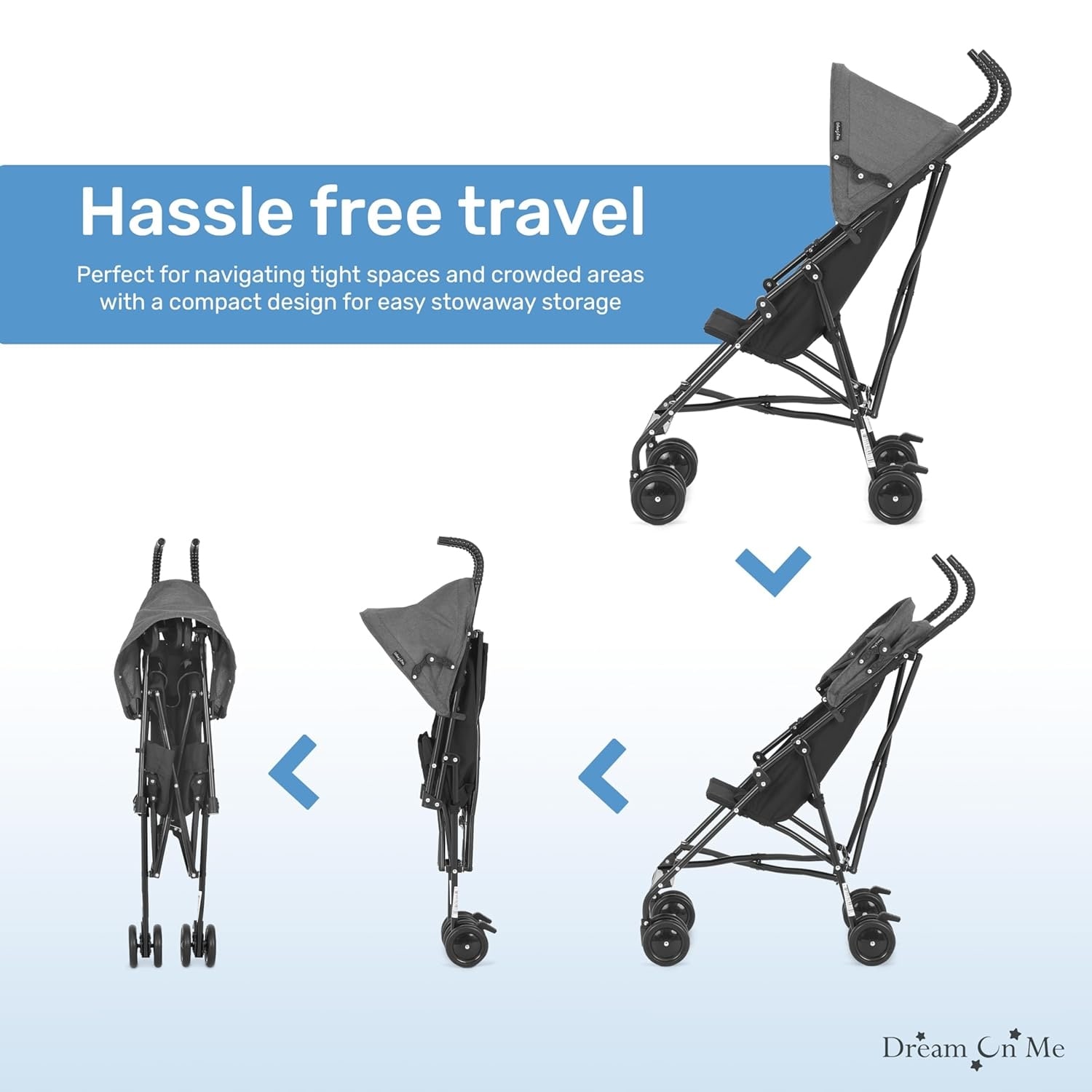
Dream On Me Aero Travel Umbrella Stroller, One-Hand Quick Fold
Ultra-Budget PickDream On Me · $32.49
Price last checked August 15, 2026 — see Amazon for current pricing.
Functional umbrella stroller at $34 — one-hand fold, 11 lbs, and cheap enough to not worry about.
Pros
- Incredibly affordable under $35
- One-hand quick fold
- Adjustable removable canopy
- Lightweight and compact
Cons
- Basic construction
- Minimal padding
- Limited recline
This product is featured in our Best Travel Strollers for Flying roundup.
How we assessed this
We have not personally tested this product. This assessment is built from the manufacturer's published specification, the safety standards the product is certified against, and comparison with the alternatives in its category. Where a question can only be answered by handling the product — how a fabric feels, whether a mechanism stiffens after a year — we say so rather than guess. Full methodology: How We Research.
Quick Verdict
The Dream On Me Aero is the best stroller for situations where stroller damage is likely and stress is unnecessary. At $34, it is a disposable-priced tool that handles the basics — moving a child from point A to point B — without the emotional attachment of a $300 investment. The one-hand fold is genuinely quick, the 11-pound weight is easy to carry, and the construction is adequate for intermittent travel use. The trade-offs are significant — no recline, minimal comfort features, basic build quality — and parents should not expect this to replace a primary stroller. But as a travel beater, an airport gate-check stroller, or a backup at grandparents' house, the Aero does the job at a price that makes worrying irrational.
Who This Is For
- Gate-check warriors — zero anxiety about damage in the cargo hold
- Beach and theme park families — sand, rain, and rough handling will not ruin your investment
- Grandparents who need a stroller — leave one at their house for $34
- Backup stroller families — keep one in the trunk for emergencies
- Ultra-budget travelers — functional stroller for less than the airport parking fee
Who Should Skip
- Parents who need a nap-capable stroller — no recline means no comfortable napping
- All-day outing families — minimal padding and no storage mean discomfort and inconvenience over hours
- Parents of infants under 6 months — the upright-only seat is not appropriate for babies who cannot sit unassisted
- Anyone who expects premium ride quality — the small hard wheels feel every sidewalk crack
Key Features Deep Dive
One-Hand Quick Fold
The Aero folds using a single trigger mechanism on the handlebar. Squeeze the trigger, push the handlebar forward, and the stroller collapses into an umbrella fold. The fold is genuinely one-handed — you can hold your child or a bag with the other hand. The folded stroller is long and narrow, typical of umbrella-style folds.
The fold speed is about three seconds from standing to folded. At the airplane jet bridge, this means you can fold the stroller, hand it to the gate agent, and keep walking without holding up the line. At the car, you can fold it while holding a squirming toddler. The one-hand operation is the Aero's best feature by a significant margin.
The folded dimensions are approximately 42 by 10 by 10 inches. This is compact enough for gate-checking and car trunks but not compact enough for airplane overhead bins. Like all umbrella-fold strollers, the length makes it awkward in tight spaces.
11-Pound Weight
At 11 pounds, the Aero is lighter than most full-featured umbrella strollers (the Kolcraft Cloud Plus is 12 lbs, the Summer 3Dlite is 13 lbs) and heavier than ultra-compact travel strollers (the gb Pockit is 9.5 lbs). The weight is manageable for carrying from car to destination, up stairs, or through the airport.
The light weight comes from minimal materials — less padding, thinner frame tubes, smaller wheels. This is an honest trade-off. You cannot have an 11-pound stroller with plush padding, large wheels, and a reclining seat. The Aero is light because it is simple, and it is simple because it costs $34.
Removable Canopy
The canopy is a basic fabric panel that extends over the seat to provide sun coverage. It covers roughly the top half of the seat opening — enough to shade a child's face and upper body but not full-coverage like a multi-panel canopy with an extendable visor. The canopy is removable, which is useful when folding (less bulk) or when the child is old enough to not need shade.
The canopy does not have UPF ratings, a peek-a-boo window, or an extension flap. It blocks direct overhead sun. For a $34 stroller, this is the expected level of canopy functionality.
Dual Rear Brakes
The rear wheels have individual brake pedals — step on to engage, step on the release to disengage. The brakes hold on flat surfaces and gentle slopes. On steep inclines, the small wheels may slide slightly on smooth surfaces even with brakes engaged.
The brakes are a non-negotiable safety feature, and the Aero includes them. They work. They are not the most elegant brake mechanism — the pedals are small and sometimes require a firm step — but they lock the wheels and prevent rolling.
3-Point Harness
The Aero uses a 3-point harness (waist and crotch strap) rather than a 5-point harness. The 3-point system keeps the child in the seat but does not provide shoulder restraint. For a stroller used with toddlers who can sit independently, the 3-point harness is adequate. For younger babies closer to the 6-month minimum age, a 5-point harness would provide more security.
What We Love
The price eliminates anxiety. This is the Aero's fundamental value proposition. When we gate-check a $300 stroller, we worry. When we gate-check the Aero, we do not. When sand gets into the wheel bearings at the beach, we do not care. The $34 price makes the stroller a tool rather than an investment, and the mental freedom this provides is disproportionate to the dollar amount.
The one-hand fold is legitimately fast. Faster than our Kolcraft Cloud Plus, faster than our old jogger, and faster than comparable compact-fold stroller. Three seconds, one hand, no bending down to pull triggers or press buttons. At the airport jet bridge where you are juggling a child, a carry-on, and boarding passes, this speed matters.
11 pounds carries easily. On the occasions when we need to carry the folded stroller — up stairs, through a turnstile, across a parking lot — 11 pounds is manageable. It is not as effortless as the gb Pockit's 9.5 pounds, but it is light enough for one-arm carrying for short distances.
It is a perfectly fine stroller for short trips. A walk to the park, a grocery run, a stroll through a mall — for trips under an hour, the Aero performs adequately. The wheels roll, the brakes hold, the child sits comfortably enough. It does not need to be great for everything. It needs to be good enough for the trips you use it for.
What We Don't Love
No recline is a real limitation. Toddlers fall asleep in strollers. When they fall asleep in the Aero, their head lolls forward because there is nowhere for it to go. For any outing where a nap is likely, we bring a different stroller. The Kolcraft Cloud Plus at $88 adds a reclining seat and is worth the upgrade for all-day use.
The ride quality is rough. Small, hard plastic wheels transmit every sidewalk crack, every bump, and every pebble directly to the child. On smooth surfaces — mall floors, airport terminals — the ride is fine. On outdoor sidewalks, cobblestone, gravel, or grass, the vibration is noticeable and unpleasant. Premium strollers have suspension or larger, air-filled wheels that absorb imperfections. The Aero has neither.
The padding is minimal. The seat is a single layer of fabric over the frame with light padding in the seat area. A folded blanket in the seat adds cushioning but also adds bulk.
No storage basket. The Aero has no under-seat storage. This means no place for a diaper bag, snacks, or purchases. Everything goes on the handles (tipping risk), in a separate bag you carry, or in a clip-on stroller organizer accessory. For a quick errand, this is manageable. For an all-day outing, the lack of storage is a significant inconvenience.
The 3-point harness is basic. A 5-point harness with shoulder straps would provide better security, especially for younger toddlers who lean forward or to the side. The 3-point waist-and-crotch strap keeps the child in the seat but does not prevent forward slumping.
How It Compares
vs. Kolcraft Cloud Plus ($88): The Cloud Plus adds a reclining seat, a storage basket, parent and child trays, and thicker padding. For $54 more, you get a stroller that handles all-day outings, naps, and storage. The Cloud Plus is the better stroller for families who want one travel stroller that does everything. The Aero is the better stroller for families who want a cheap backup they do not worry about.
vs. gb Pockit ($230): The Pockit folds to the size of a handbag and fits in overhead bins. It is in a completely different league for compactness. But it costs nearly seven times more. For families who need overhead bin compatibility, the Pockit justifies the price. For families who gate-check and want minimal financial risk, the Aero at $34 is the practical alternative.
vs. Summer Infant 3Dlite ($80): The 3Dlite is the mid-range umbrella stroller standard — reclining seat, decent storage, slightly better build quality. At $80, it is more than double the Aero's price but provides a more complete feature set. For a primary travel stroller, the 3Dlite is the better investment. For a beater stroller, the Aero's $34 price point is the whole argument.
vs. No stroller (using a carrier only): For short outings under an hour with toddlers under 25 pounds, a carrier works. For anything longer, the Aero provides a place to set the child down, which your back will appreciate. At $34, it is cheaper than the massage you will need after carrying a toddler through a theme park all day.
Dream On Me Aero Travel Umbrella Stroller, One-Hand Quick Fold
$32.49by Dream On Me
Best For
- ✓Incredibly affordable under $35
- ✓One-hand quick fold
- ✓Adjustable removable canopy
Price last checked August 15, 2026and subject to change — see Amazon for current pricing. As an Amazon Associate we earn from qualifying purchases.
Final Verdict
The Dream On Me Aero is not the best stroller on the market and does not try to be. It is the one you worry about least, and for travel that is often the more useful property. At $34 it removes the financial anxiety around gate-checking, sand, theme parks and every other scenario where damage is likely. It folds in three seconds one-handed, weighs 11 pounds, and does the basics — rolling, braking, shading — without pretending to more.
The limitations are honest and predictable: no recline, no storage, no plush comfort, no premium ride quality. These are the features that $34 buys you out of. For families who need a primary travel stroller that handles everything, spend more and get the Kolcraft Cloud Plus or the Stokke YOYO3. For families who need a stroller they can throw in the trunk, gate-check without a second thought, and replace without flinching, the Dream On Me Aero is the answer that no one talks about because it is not exciting enough to generate conversation. But it works, it lasts longer than you would expect for $34, and it lets you focus your travel budget on the trip rather than the gear.
Frequently Asked Questions
Products Mentioned
Related Content
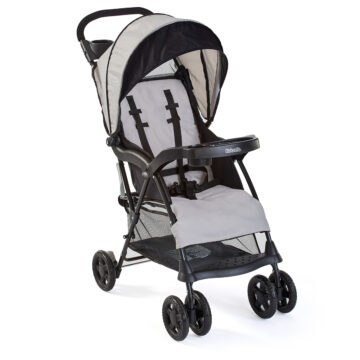
Kolcraft Cloud Plus Review: The Budget Stroller That Does Not Feel Like a Budget Stroller
Honest Kolcraft Cloud Plus review — reclining seat, storage basket, parent and child trays, all under $90. $95.61. Specs, trade-offs, and who should skip it.
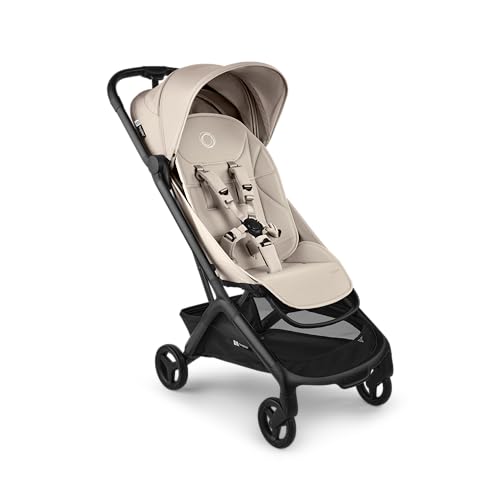
Bugaboo Butterfly 2: The One-Second Fold, and What $499 Actually Buys
A spec-led look at the Bugaboo Butterfly 2 — the one-second fold, IATA-compatible dimensions, full suspension, and the 48-month age range that separates it from cheaper ultra-compacts.
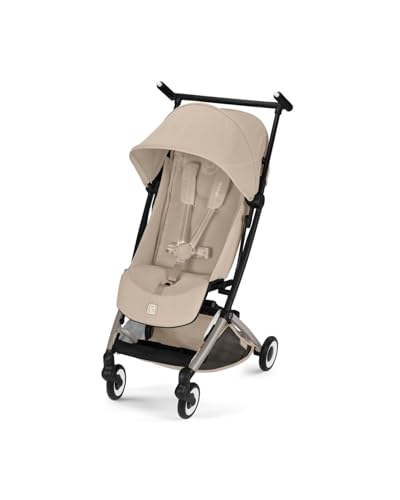
Cybex Libelle: 13.7 Pounds and Carry-On Compliant
A spec-led look at the Cybex Libelle — 13.7 lbs, carry-on compliant, travel-system ready from birth with a compatible Cybex infant seat, and where the compromises land at $349.95.